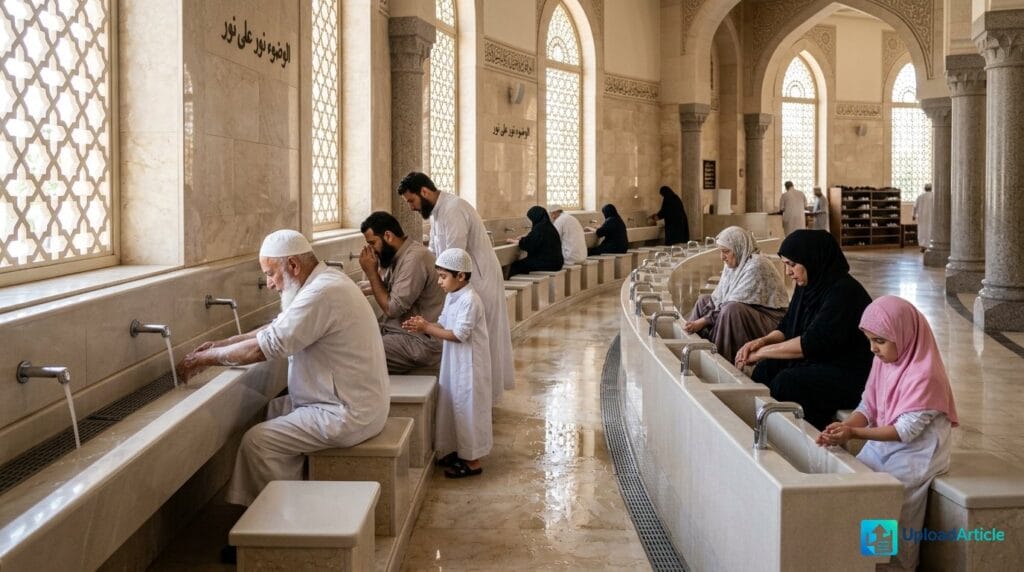
A wudu basin is far more than a sink. It is the physical threshold between the mundane and the sacred, the point where a worshipper washes away the dust of daily life and prepares to stand before Allah in prayer. For centuries, mosques relied on simple troughs, communal fountains, or rows of standard washbasins to facilitate this ritual. Those solutions worked, but they came with persistent problems: slippery floors from splashed water, back strain from awkward bending, congestion during peak prayer times, and surfaces that harbored mold in the grout lines between tiles.
The modern wudu basin has changed every element of that equation. Advances in material science, ergonomic engineering, and inclusive design have produced ablution fixtures that are cleaner, safer, more accessible, and more dignified than anything that came before. A well-designed unit today can accommodate a standing adult, a seated elderly worshipper, and a wheelchair user at the same station. Its surface resists bacterial colonization. Its contours guide water into the drain rather than onto the floor. Its sensor faucet delivers exactly the amount of water needed for each washing step, conserving a resource that Islam explicitly commands believers not to waste.
This article examines how the contemporary wudu basin elevates hygiene, expands accessibility, and enhances comfort in modern ablution areas. Whether you are an architect specifying fixtures for a new mosque, a facility manager planning a retrofit of an existing prayer space, or a homeowner installing a dedicated wudu basin for private use, the principles and data in this guide will help you make an informed decision grounded in Islamic values and modern engineering.
The Hygiene Revolution: How the Modern Wudu Basin Prevents Contamination and Promotes Cleanliness
Hygiene is not a secondary consideration in ablution design. It is the core purpose of wudu itself. A wudu basin that harbors bacteria, accumulates biofilm, or spreads waterborne pathogens defeats the very ritual it is meant to serve. The hygiene performance of any unit depends on three interconnected factors: the material it is made from, the geometry of its surfaces, and the technology that controls water delivery and drainage.
Material Science and the Hygienic Wudu Basin
The single most important hygiene decision in any specification is the choice of material. The difference between a porous and a non-porous surface is the difference between a breeding ground for microbes and a surface that passively resists contamination.
Traditional ceramic units perform adequately in low-traffic settings. The glaze provides a reasonably non-porous finish, and ceramic is easy to clean with standard disinfectants. However, ceramic is brittle. A chip or crack in the glaze exposes the porous bisque underneath, creating a refuge for bacteria that routine cleaning cannot reach. Ceramic installations in high-traffic mosques often show visible wear within three to five years, with grout lines between tiled surrounds compounding the hygiene problem.
Stainless steel options offer excellent durability and a genuinely non-porous surface. Grade 304 stainless steel resists corrosion, tolerates aggressive cleaning agents, and presents no hiding places for pathogens. The tradeoff is aesthetic and thermal. Stainless steel feels cold to the touch, shows water spots readily, and can feel institutional rather than spiritual in a worship environment. It also conducts sound — a row of stainless steel units in a reverberant mosque can become unpleasantly noisy during peak use.
Solid surface has emerged as the preferred material for the modern version. Composed of acrylic resin blended with mineral fillers, solid surface is non-porous, warm to the touch, and seamless. A solid surface wudu basin contains no grout lines, no joints, and no crevices where moisture can accumulate and bacteria can colonize. The material can be thermoformed into virtually any shape, allowing designers to create continuous, coved transitions between the basin bowl, the foot-washing ledge, the counter surface, and the integrated seating. There is simply nowhere for dirt to hide.
The table below compares the hygiene performance of the three primary wudu basin material categories.
| Hygiene Factor | Ceramic Wudu Basin | Stainless Steel Wudu Basin | Solid Surface Wudu Basin |
|---|---|---|---|
| Surface porosity | Low (glaze intact); high if chipped | None | None |
| Grout/joint lines | Present in tiled surrounds | Present at seams | Eliminated (seamless fabrication) |
| Mold resistance | Moderate | High | Very high |
| Bacterial adhesion | Low on intact glaze | Low | Low |
| Chemical cleaning tolerance | Moderate (avoid abrasives) | High (most chemicals safe) | High (pH-neutral cleaners recommended) |
| Surface repairability | None (replace if chipped) | None (replace if dented) | High (sanding and buffing restores finish) |
| Typical lifespan in high-traffic mosque | 5–10 years | 15–20 years | 15–25 years |
Water Management and Splash Control in the Wudu Basin
A basin that splashes water onto the surrounding floor creates two hygiene problems simultaneously. The wet floor becomes a slip hazard and a medium for fungal growth, while the standing water around the basin supports biofilm development in the grout lines and corners that cleaning staff struggle to reach.
The geometry of a well-designed wudu basin actively prevents this outcome through several deliberate design elements:
- Deeper bowl depth, typically 150 to 200 millimeters from rim to drain, with steeply sloped sides that direct water inward rather than outward
- A foot-washing ledge angled backward at 5 to 10 degrees so that water flows toward the drain rather than toward the user
- Integrated splash guards consisting of raised lips along the front and side edges that contain water within the basin envelope at full faucet pressure
- Separate foot-washing troughs positioned below the hand-washing bowl in dual-level configurations so the user never lifts a wet foot over a dry floor
- Anti-slip textured surfaces in the foot-washing zone that provide secure footing even when soap and water are present
Many contemporary wudu basin designs incorporate a separate foot-washing trough positioned below the hand-washing bowl. This dual-level configuration means the user never needs to lift a wet foot over a dry floor. The foot remains within the wet zone from the moment it enters the trough until the moment it exits onto a drying mat. The floor stays dry. The air stays free of the musty odor that characterizes poorly drained ablution areas.
Sensor Technology and the Hygienic Wudu Basin
Touchless faucets have moved from luxury to expectation in the modern market. The hygiene case is straightforward: a sensor-activated wudu basin eliminates the single most contaminated touchpoint in any ablution area — the faucet handle. Every worshipper who touches a manual faucet after washing transfers whatever remained on their hands back onto the handle, where the next user picks it up.
Sensor faucets solve this through infrared detection. The user places their hands under the spout, water flows, and when the hands are removed, water stops. No contact. No cross-contamination. The benefits of sensor activation in a wudu basin extend across multiple dimensions:
- Elimination of the faucet handle as a cross-contamination vector, reducing bacterial transfer between consecutive users during peak prayer times
- Automatic shutoff that prevents water waste when the user moves between washing steps, conserving 35 to 50 percent more water than manual faucets
- Integration with sensor-activated soap dispensers built directly into the basin counter rather than wall-mounted units that create drip-related cleaning burdens
- Timed flow programming in advanced models that delivers the precise duration needed for each wudu step before automatically stopping
- Enhanced accessibility for users with limited hand mobility, arthritis, or conditions that make gripping and turning manual handles difficult or painful
The data supports the hygiene advantage. Studies of touchless versus manual faucet installations in healthcare and high-traffic public facilities consistently find lower bacterial counts on sensor-activated fixtures. A wudu basin equipped with sensor faucets, sensor soap dispensers, and hands-free hand dryers or disposable towel dispensers represents the current hygiene benchmark for communal ablution spaces.
Accessibility by Design: How the Modern Wudu Basin Welcomes Every Worshipper
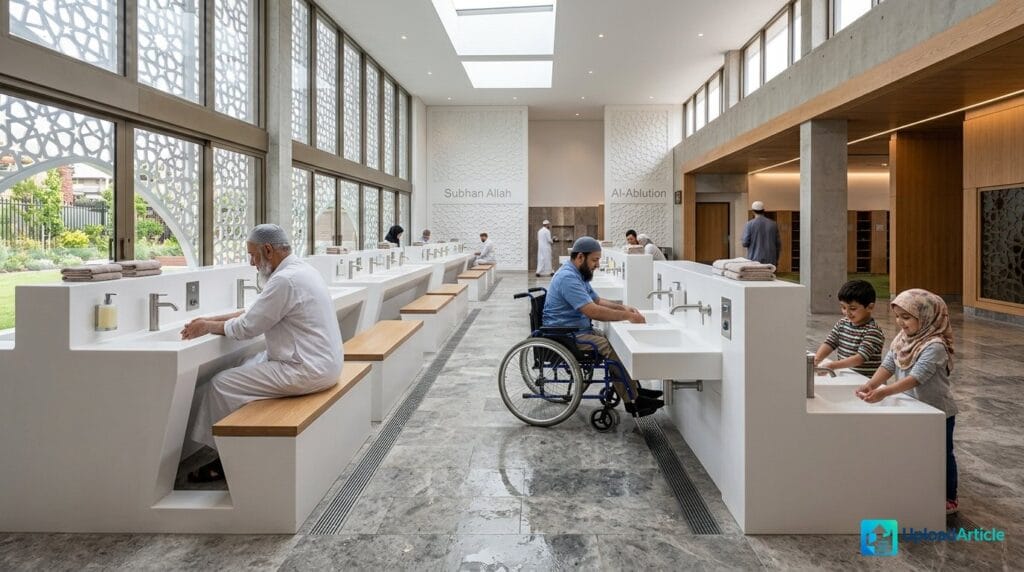
Islam commands inclusivity. The Prophet Muhammad, peace be upon him, prayed among the young and the old, the able-bodied and the infirm, the rich and the poor. A mosque that designs its ablution area exclusively for young, physically capable worshippers has failed a fundamental test of Islamic hospitality. The modern wudu basin addresses this obligation through deliberate design choices that accommodate the full spectrum of human physical ability.
Dual-Height and Multi-Level Wudu Basin Configurations
The most immediate barrier in a traditional ablution area is height. A standard standing-height wudu basin — with its rim at 850 to 900 millimeters above the floor and its foot-washing ledge elevated even higher — is physically inaccessible to a wheelchair user. It is difficult and potentially dangerous for an elderly worshipper with reduced flexibility and balance. It is simply out of reach for a child.
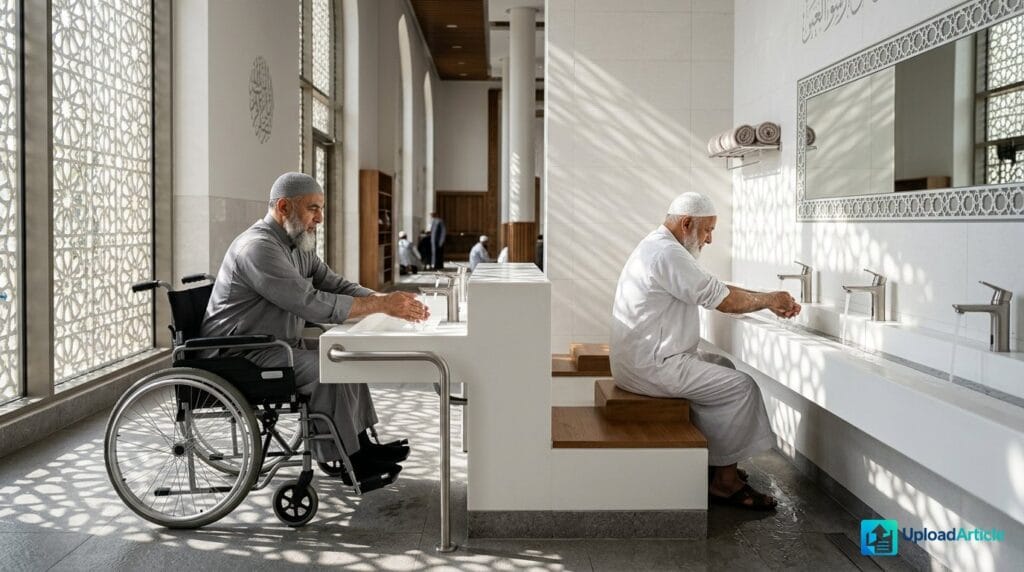
The dual-height wudu basin solves this by providing two or more washing stations at different elevations within the same counter run. The standing stations maintain the conventional 850 to 900 millimeter height. The seated stations drop to 700 to 750 millimeters, with open knee clearance beneath the basin bowl that accommodates a wheelchair footrest. The foot-washing trough at the accessible station sits low enough — typically 150 to 200 millimeters above the floor — that a seated user can place their foot into it without lifting their leg against gravity.
The table below summarizes the recommended dimensional standards for accessible wudu basin design.
| Dimension | Standing Wudu Basin | Seated/Accessible Wudu Basin |
|---|---|---|
| Basin rim height | 850–900 mm | 700–750 mm |
| Knee clearance below basin | Not required | Minimum 680 mm height × 750 mm width |
| Foot trough height | 250–350 mm | 150–200 mm |
| Grab bar mounting height | 800–900 mm (horizontal) | 700–800 mm (horizontal) |
| Clear floor space | 750 × 1200 mm | 1500 mm diameter turning circle |
| Faucet reach distance | 400–500 mm from user | 300–400 mm from seated user |
Supportive Seating and Grab Bars in the Wudu Basin Area
For elderly worshippers who can stand but cannot comfortably balance on one foot while washing the other, integrated seating transforms the wudu basin from a challenge into a relief. Fixed stools made from stainless steel or solid surface are positioned directly adjacent to the basin bowl, allowing the user to sit while washing their hands, face, and arms, then pivot slightly to place each foot into the washing trough without ever needing to stand on one leg.
These stools are not afterthoughts bolted onto a finished installation. In the best contemporary wudu basin designs, the seat is fabricated from the same solid surface material as the basin itself and integrated into the counter as a continuous, seamless element. There are no gaps where water can pool, no bolts that can corrode, and no joints that can loosen over years of daily use.
Grab bars complement the seating and are essential safety elements in any accessible wudu basin installation:
- Horizontal grab bars installed at 700 to 800 millimeters above the floor adjacent to the accessible station provide stability during sitting and standing transitions
- Vertical grab bars near the entrance to the ablution area assist users who rely on walking aids or need support navigating the threshold
- All grab bars should be rated for a minimum load of 150 kilograms and finished in a contrasting color to the wall for visibility by partially sighted worshippers
- Rounded edges and seamless joints on all grab bar terminations prevent injury from accidental contact in the wet ablution environment
Spatial Planning for the Accessible Wudu Basin Environment
Accessibility begins long before the worshipper reaches the wudu basin itself. The approach path and surrounding environment must meet several design standards:
- Doorways into the ablution area should be a minimum of 900 millimeters wide, with lever handles rather than knobs that require gripping and twisting
- The floor throughout must be level or ramped — never stepped — and finished with anti-slip tiles rated R11 or higher to prevent falls on wet surfaces
- A turning circle of at least 1500 millimeters in diameter must be maintained in front of the accessible wudu basin station for wheelchair maneuverability
- Circulation paths between rows of wudu basin units should be a minimum of 1200 millimeters wide to accommodate two wheelchair users passing each other
- Visual contrast between flooring, walls, and basin surfaces assists partially sighted worshippers in orienting themselves within the ablution space
Within the ablution area, a turning circle of at least 1500 millimeters in diameter must be maintained in front of the accessible wudu basin station. This allows a wheelchair user to approach, position themselves at the basin, complete wudu, and turn to exit without reversing or performing a multi-point turn. The circulation path between rows of wudu basin units should be a minimum of 1200 millimeters wide to accommodate two wheelchair users passing each other.
Comfort and Ergonomics: The Forgotten Dimensions of Wudu Basin Design
Comfort in ablution may seem like a secondary concern compared to hygiene and accessibility, but it is not. A wudu basin that causes physical discomfort — back pain from bending, neck strain from a poorly positioned faucet, cold shock from a freezing metal surface — distracts the worshipper from the spiritual focus that wudu is meant to cultivate. The ritual becomes something to endure rather than an act of mindful preparation.
Ergonomic Geometry of the Contemporary Wudu Basin
The human body follows predictable ranges of motion. A well-designed wudu basin respects those ranges and works within them. Key ergonomic parameters that distinguish a thoughtfully designed unit include:
- Faucet spout positioned so the user can place both hands beneath it without hunching their shoulders or craning their neck forward
- Basin depth calibrated to allow face washing without water splashing back onto the user’s clothing or the surrounding floor
- Foot-washing ledge accessible without the user needing to lift their foot above knee height, which would strain the hip flexor and challenge balance
- Basin rim height set between 850 and 900 millimeters for standing users and 700 to 750 millimeters for seated or wheelchair-using worshippers
- Faucet reach distance of 400 to 500 millimeters from the user’s standing position, reduced to 300 to 400 millimeters for seated stations
These are not subjective preferences. They are measurable ergonomic parameters that separate a thoughtfully designed wudu basin from one that merely meets a specification sheet. The best manufacturers invest in anthropometric research, studying users of different heights, ages, and physical abilities to determine optimal dimensions. The result is a wudu basin that feels instinctively right — the user performs wudu without ever noticing the fixture, because nothing about it fights their body’s natural movements.
Thermal Comfort and the Wudu Basin Experience
Water temperature matters in wudu. The Sunnah does not prescribe a specific temperature — the Prophet, peace be upon him, performed ablution with whatever water was available — but modern worshippers in cold climates have a legitimate expectation of comfort. A unit plumbed only with cold water in a mosque in Chicago in January delivers a physically jarring experience that detracts from spiritual presence.
The solution is thermostatic mixing valves integrated into the wudu basin supply line. These valves blend hot and cold water to a preset temperature, typically 30 to 35 degrees Celsius, delivering consistent warmth regardless of fluctuations in the building’s water supply. The valves also include a maximum temperature limit to prevent scalding, which is essential in facilities used by children and elderly worshippers who may have reduced temperature sensitivity.
Acoustic Comfort and the Wudu Basin Environment
Noise is the most overlooked comfort factor in ablution area design. A large ablution hall with twenty ceramic or stainless steel wudu basin units, hard tile floors, and hard wall surfaces becomes an echo chamber during peak use. The cumulative sound of running water, splashing, footfalls, and conversation can exceed 75 decibels — loud enough to be physically stressful and incompatible with the tranquility that should precede prayer.
Solid surface wudu basin units offer a significant acoustic advantage. The material is denser and more sound-absorbent than stainless steel and less resonant than ceramic. When combined with acoustic ceiling panels, sound-absorbing wall treatments, and soft-close faucet mechanisms, a solid surface installation can reduce ambient noise levels by 10 to 15 decibels compared to a traditional tile-and-ceramic ablution hall.
Material Choices: Selecting the Right Wudu Basin for Your Facility
The material of a wudu basin determines its hygiene performance, its durability, its appearance, its thermal feel, and its cost. The specification decision should be driven by the expected usage volume, the available maintenance budget, and the aesthetic character of the surrounding space. A one-size-fits-all approach leads to expensive mistakes.
Solid Surface Wudu Basin: The Premium Standard
Solid surface has become the specification benchmark for high-traffic mosque wudu basin installations for reasons that extend beyond hygiene. The material is warm to the touch, eliminating the cold shock associated with stainless steel. It is repairable — minor scratches and scuffs can be sanded and buffed back to a factory finish by maintenance staff without replacing the unit. It is customizable in color and form, allowing architects to match the wudu basin to the mosque’s interior palette and create flowing, organic shapes that ceramic cannot achieve.
A commercial-grade solid surface wudu basin with integrated seating, sensor faucet, and accessible dual-level configuration typically costs between $800 and $2,500 per station, depending on size, complexity, and the manufacturer. This is higher than ceramic but lower than premium stainless steel, and the total cost of ownership over a 20-year lifespan — factoring in reduced maintenance, repairability, and retained appearance — strongly favors solid surface.
Ceramic Wudu Basin: The Budget-Conscious Option
Ceramic remains a viable choice for low-traffic wudu basin applications: private homes, small prayer rooms in office buildings, and mosques with fewer than 50 daily worshippers. A quality ceramic wudu basin with a high-gloss glaze, pedestal or wall-mounted installation, and manual faucet can be purchased for $150 to $500 per unit. The material is familiar to plumbers, easy to clean with standard bathroom products, and available in a wide range of styles from traditional to contemporary.
The limitation of ceramic is not its initial performance but its long-term durability. Every ceramic wudu basin will eventually chip or crack in a high-traffic environment. When it does, the only remedy is replacement. The grout lines in the surrounding tile installation will require regular scrubbing and periodic re-grouting. Over a 15-year horizon, the maintenance costs of a ceramic wudu basin installation in a busy mosque can equal or exceed the initial cost premium of solid surface.
Stainless Steel Wudu Basin: The Industrial Workhorse
Stainless steel occupies a specific niche in the wudu basin market. It is the material of choice for outdoor ablution areas, where UV exposure would degrade solid surface and thermal cycling would crack ceramic. It excels in facilities that require frequent aggressive cleaning with industrial disinfectants — airport prayer rooms, highway rest-stop mosques, and stadium ablution areas. A Grade 304 stainless steel wudu basin trough serving multiple users simultaneously is virtually indestructible.
The aesthetic limitation is real. Stainless steel reads as institutional. In a beautifully appointed mosque with marble floors, intricate tile work, and warm lighting, a row of stainless steel wudu basin units can feel visually discordant. Some manufacturers address this through powder-coated finishes in white or beige, but the underlying material character remains. Stainless steel is the right choice when durability trumps aesthetics, and the wrong choice when the opposite is true.
The table below summarizes the selection criteria for wudu basin materials across different facility types.
| Facility Type | Recommended Wudu Basin Material | Typical Unit Cost (USD) | Key Decision Driver |
|---|---|---|---|
| Large mosque (500+ daily users) | Solid surface | $1,200–$2,500 | Hygiene, durability, repairability, aesthetics |
| Medium mosque (100–500 daily users) | Solid surface or premium ceramic | $500–$1,500 | Balance of cost and longevity |
| Small mosque (under 100 daily users) | Ceramic or solid surface | $200–$800 | Budget with acceptable durability |
| Private home | Ceramic | $150–$500 | Cost, compact size, ease of installation |
| Office prayer room | Solid surface or ceramic | $300–$1,000 | Space efficiency, professional appearance |
| Outdoor ablution area | Stainless steel | $400–$1,200 | Weather resistance, vandal resistance |
| Airport or stadium prayer facility | Stainless steel | $600–$2,000 | Extreme durability, industrial cleaning tolerance |
Water Conservation and the Eco-Conscious Wudu Basin
The Prophet Muhammad, peace be upon him, instructed Muslims not to waste water in ablution, even if performing wudu beside a flowing river. This teaching carries urgent contemporary relevance. A traditional wudu basin with a manual faucet left running throughout the ablution sequence can consume 10 to 15 liters of water per wudu. For a mosque serving 500 worshippers across five daily prayers, that translates to 25,000 to 37,500 liters of water every single day.
The modern wudu basin addresses this through sensor technology and flow regulation. An infrared sensor faucet activates only when hands are detected beneath the spout, cutting water consumption by 35 to 50 percent compared to a continuously running manual faucet. Flow restrictors built into the faucet aerator limit output to 4 to 6 liters per minute without reducing perceived water pressure — the user feels a full, satisfying stream while using less than half the water of an unrestricted faucet.
Some advanced wudu basin installations take conservation further. Programmable faucets deliver a timed flow — 15 seconds for hand washing, 10 seconds for mouth rinsing, 5 seconds for nose rinsing — after which the user simply waves to restart the cycle. Foot-pedal controls offer an alternative to sensors, allowing the user to activate water flow by pressing a floor-mounted pedal that shuts off automatically when released. Both approaches eliminate the waste of an inadvertently left-open faucet.
The water savings are not just environmentally virtuous. They are financially significant. A mosque that reduces its daily water consumption by 15,000 liters through efficient wudu basin fixtures can save $1,500 to $3,000 annually on water and sewer charges, depending on local utility rates. Over the 20-year lifespan of a solid surface wudu basin installation, those savings offset a meaningful portion of the initial capital investment.
Installation and Maintenance: Ensuring the Long-Term Performance of Your Wudu Basin
A wudu basin is a long-term investment. The most beautifully designed unit will disappoint if it is poorly installed or inadequately maintained. This section covers the practical considerations that determine whether a wudu basin installation delivers its promised performance across decades of daily use.
Plumbing Infrastructure for the Wudu Basin
The plumbing requirements of a wudu basin differ from those of a standard washbasin in several important respects:
- The drain must handle a higher volume of water discharged in shorter bursts — a wudu user typically empties the basin rapidly after foot washing rather than letting water drain gradually
- The trap must accommodate occasional sediment from foot washing without clogging, requiring wider-diameter P-traps than standard sink installations
- Hot water supply, if provided, must be regulated through a thermostatic mixing valve to maintain consistent temperature and prevent scalding
- Floor drains should be positioned beneath each wudu basin station to provide a secondary drainage path for any water escaping the basin
- Multi-station installations require cleanouts accessible at multiple points along the main waste line so a single blockage does not disable the entire row
For multi-station wudu basin installations, the drainage system should be designed with cleanouts accessible at multiple points along the main waste line. A blockage in a single basin’s trap should not disable the entire row. Floor drains positioned beneath each wudu basin station provide a secondary drainage path for any water that escapes the basin — a practical concession to the reality that even the best splash control cannot prevent every drop from reaching the floor in a facility used thousands of times daily.
Daily and Weekly Wudu Basin Maintenance Protocols
The maintenance requirements of a wudu basin are straightforward but non-negotiable. Daily cleaning should include wiping all basin surfaces with a soft microfiber cloth and a mild pH-neutral cleaner to remove soap residue, skin oils, and water spots. Faucet spouts, sensor lenses, and manual handles should be disinfected with a diluted vinegar solution or a commercial quaternary ammonium disinfectant. Drains should be flushed with hot water to clear soap buildup and prevent odor development.
Weekly deep cleaning of the wudu basin should address areas that daily wiping misses: the underside of the basin rim, the junction between the basin and the counter or wall, the foot-washing trough grate, and the interior of the drain trap. A soft brush and baking soda paste can remove mineral deposits from hard water without scratching the basin surface. Bleach and abrasive cleaners should be avoided entirely on solid surface and ceramic wudu basin units, as they dull the finish and create microscopic scratches where bacteria can shelter.
The table below outlines a recommended maintenance schedule for high-traffic wudu basin installations.
| Maintenance Task | Frequency | Method | Products to Use |
|---|---|---|---|
| Surface wipe-down | After each prayer time | Microfiber cloth, spray cleaner | pH-neutral cleaner |
| Faucet and sensor disinfection | Daily | Wipe with disinfectant | Diluted vinegar or quaternary ammonium |
| Drain flush | Daily | Hot water pour | Hot water only |
| Deep clean basin interior | Weekly | Soft brush, non-abrasive paste | Baking soda and water |
| Grout inspection (ceramic installations) | Monthly | Visual inspection, spot scrub | Mold-resistant grout sealer as needed |
| Sensor calibration check | Quarterly | Test activation range and shutoff | Per manufacturer instructions |
| Trap cleanout | Annually | Remove and clean P-trap | Hot water and mild detergent |
| Professional surface restoration | Every 3–5 years (solid surface) | Sanding and refinishing | Professional service |
Frequently Asked Questions About the Wudu Basin
1. What is a wudu basin and how does it differ from a regular sink?
A wudu basin is a purpose-built ablution fixture designed specifically for the Islamic ritual of wudu. Unlike a standard sink, a wudu basin includes an integrated foot-washing area with an angled trough or ledge, deeper bowl geometry to minimize splashing, and ergonomic dimensions that accommodate the full sequence of washing the hands, mouth, nose, face, arms, head, ears, and feet. The best wudu basin designs incorporate non-porous solid surface materials, sensor-activated faucets, and optional integrated seating for elderly and disabled users.
2. Can a wudu basin be installed in a private home?
Yes. Compact wudu basin units designed specifically for residential installation are widely available. These range from simple ceramic pedestal models requiring only standard plumbing connections to integrated solid surface units with built-in seating. A residential wudu basin typically occupies a footprint of 450 by 640 millimeters and can be installed in an existing bathroom, a dedicated ablution alcove, or a mudroom adjacent to the home’s prayer space. Installation generally requires a hot and cold water supply, a 32-millimeter waste connection, and compliance with local plumbing codes.
3. What is the best material for a wudu basin in a high-traffic mosque?
Solid surface is the consensus choice among architects and facility managers for high-traffic mosque wudu basin installations. Its non-porous, seamless construction eliminates the grout lines and joints where bacteria thrive in ceramic-tiled installations. It is warm to the touch, repairable if scratched, and can be custom-fabricated into dual-height configurations with integrated seating that serve standing, seated, and wheelchair-using worshippers at the same station. The initial cost premium over ceramic is typically recovered through reduced maintenance and longer service life within the first decade of operation.
4. How does a sensor wudu basin reduce water waste?
A sensor-activated wudu basin reduces water consumption by 35 to 50 percent compared to a manually operated faucet. The infrared sensor detects the presence of hands beneath the spout and activates water flow only when needed. When the user removes their hands to perform the next step of wudu, the flow stops instantly. This eliminates the common practice of leaving a manual faucet running throughout the entire ablution sequence. Combined with flow restrictors that limit output to 4 to 6 liters per minute, a sensor wudu basin can reduce daily water consumption by thousands of liters in a busy mosque.
5. Are wudu basins required by Islamic law in mosques?
No. Islamic law does not mandate a specific type of fixture for wudu. The ritual can be performed using any clean water source, including a simple bowl, a river, or a standard sink. However, a dedicated wudu basin is strongly recommended for mosque and institutional settings because it facilitates proper foot washing without creating hazardous wet floors, accommodates worshippers with physical limitations, and maintains the dignity and hygiene of the communal ablution space. Most contemporary mosque designs specify purpose-built wudu basin installations as a matter of community responsibility and good stewardship.
6. How long does a quality wudu basin installation last?
The service life of a wudu basin depends primarily on the material and the intensity of use. A solid surface wudu basin in a well-maintained mosque can serve for 20 to 25 years before requiring replacement, with periodic surface restoration extending its aesthetic life indefinitely. A stainless steel wudu basin in an outdoor or industrial environment may last 15 to 20 years. A ceramic wudu basin in a high-traffic mosque typically requires replacement within 5 to 10 years due to chipping and glaze degradation. The longevity of any wudu basin installation is directly proportional to the consistency of daily and weekly maintenance.
Conclusion: The Wudu Basin as an Expression of Islamic Values in Built Form
The wudu basin sits at the intersection of faith and engineering, of spiritual ritual and material science. Choosing the right wudu basin for a mosque, a prayer room, or a home is not merely a procurement decision. It is an act of service to the community that will use it — a commitment to their hygiene, their safety, their dignity, and their comfort during the most intimate act of worship.
Every element of a well-designed wudu basin reflects an Islamic principle. The non-porous surface that resists contamination embodies the emphasis on purity. The sensor faucet that conserves water embodies the prohibition against waste. The dual-height configuration that welcomes wheelchair users embodies the command to inclusivity. The warm-to-touch material that soothes rather than shocks embodies the Prophetic example of gentleness. Taken together, these features transform the wudu basin from a utilitarian fixture into a physical manifestation of the values it serves.
As mosques, airports, universities, and workplaces around the world invest in modern ablution infrastructure, the wudu basin stands as a quiet testament to what happens when design takes faith seriously. It proves that the rituals of Islam need not be performed in discomfort or compromise. They can be supported, elevated, and dignified by the spaces and objects that surround them — beginning with the basin where every prayer begins.