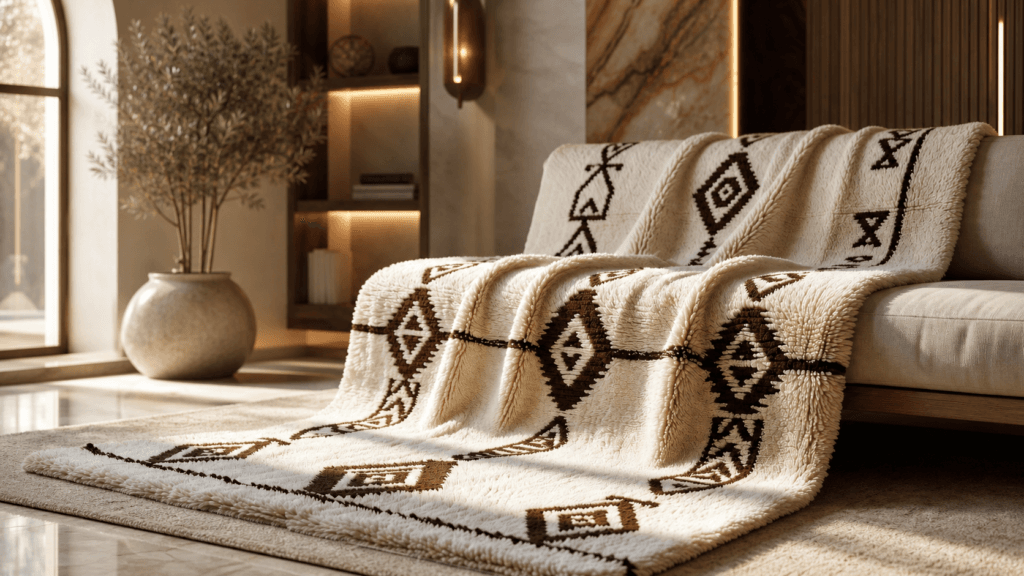
Luxury Berber rugs are much more than stunning floor coverings; they are handwoven textiles that tell the stories of ancient Moroccan tribes. Over the past decade, these unique pieces have taken the interior design world by storm. Celebrated for their plush pile, geometric patterns, and organic textures, luxury Berber rugs bring warmth and global character to any space. However, investing in an authentic Moroccan rug requires knowledge. From the iconic Beni Ourain to the vibrant Azilal, understanding the distinct weaving traditions ensures you purchase a high-quality piece that holds its value. This comprehensive guide explores the history, types, and authentication of these treasured artisan rugs, helping you make a confident and informed investment.
What Are Luxury Berber Rugs?
Berber rugs are woven by the indigenous Berber people of North Africa, primarily in the Atlas Mountains of Morocco. For centuries, these nomadic and semi-nomadic tribes utilized weaving for practical purposes. They crafted thick blankets to protect against freezing mountain temperatures. Over time, this functional craft evolved into a profound artistic expression.
Each rug is a one-of-a-kind creation. The weavers—primarily women—do not follow pre-written patterns. Instead, they weave from memory and intuition. This spontaneous creative process results in the captivating imperfections, shifting patterns, and deeply personal tribal motifs that make each rug completely unique.
The History of Moroccan Rugs and Tribal Motifs
The symbols woven into luxury Berber rugs are not merely decorative. They are a visual language passed down through generations. Common tribal motifs represent fertility, protection against the evil eye, natural elements like water and mountains, and the female weaver’s own life experiences.
When you purchase an authentic Moroccan rug, you are bringing a piece of living history into your home. The slight asymmetries and variations in the weave—often called the “soul” of the rug—are highly prized by collectors and interior designers alike.
The Different Types of Authentic Berber Rugs
Not all Moroccan rugs are the same. Different tribes developed distinct weaving styles based on their local climate, available materials, and cultural traditions. When shopping for luxury Berber rugs, it is essential to know the primary categories.
Beni Ourain Rugs: The Iconic Plush Pile
The Beni Ourain tribe hails from the snowy peaks of the Middle Atlas Mountains. To insulate against the bitter cold, they wove rugs from the wool of their fat-tailed sheep. This wool is exceptionally long, thick, and un-dyed, resulting in a famously plush pile.
Beni Ourain rugs are the most recognizable style in modern interior design. They feature thick, creamy white backgrounds intersected by bold, abstract geometric lines in dark brown or black. Their minimalistic yet organic aesthetic makes them the perfect anchor for contemporary, Scandinavian, or mid-century modern spaces.
Azilal Rugs: Vibrant Colors and Geometric Patterns
Originating from the Azilal region in the High Atlas Mountains, these rugs are a stark contrast to the muted Beni Ourain. Azilal weavers use a base of un-dyed wool. They then brilliantly weave in vibrant, colorful patterns using dyed wool and sometimes recycled cotton.
Azilal rugs feature highly expressive, abstract geometric patterns. You will find bright pops of yellow, pink, blue, and red. These high-pile rugs are incredibly cheerful and eclectic. They are ideal for homeowners looking to make a bold, artistic statement in a living room or nursery.
Boucherouite Rugs: The Art of Rag Rugs
The word “Boucherouite” comes from an Arabic phrase meaning “torn clothing” or “scraps.” These unique handwoven textiles emerged when traditional wool became scarce. Weavers began incorporating recycled fabric, clothing scraps, and even plastic into their looms.
Boucherouite rugs feature a flat or medium pile with an incredibly dense, colorful array of asymmetrical patterns. They are eco-friendly, textural, and visually dynamic. Because of their playful and scrappy nature, they work beautifully in casual spaces, creative studios, or children’s rooms.
Tazenakht Rugs: The Elegance of the Sahara
Hailing from the border of the Sahara Desert, Tazenakht rugs are known for their sophisticated elegance. They typically feature a rich saffron or deep red background. The geometric motifs are woven in intricate, precise detail using dark brown or black wool. They bridge the gap between the plush mountain rugs and the flat-woven kilims of the desert.
Why Interior Designers Love Luxury Berber Rugs
Top-tier interior designers consistently gravitate toward luxury Berber rugs. The reasons extend far beyond fleeting trends.
Versatility in Modern and Traditional Spaces
You might assume that a tribal Moroccan rug only belongs in a bohemian or eclectic room. In reality, their greatest strength is their versatility.
A minimalist, stark white modern living room benefits immensely from the soft, organic texture of a Beni Ourain rug. The thick pile adds cozy warmth, while the subtle geometric lines break up the visual monotony without cluttering the space. Conversely, a traditional or transitional room can be instantly refreshed and elevated by the global character of an Azilal rug.
The Appeal of Authentic Craftsmanship
In an era dominated by mass-produced home goods, authentic craftsmanship stands out. Interior designers prize luxury Berber rugs because they possess a soul and a story that factory-made carpets cannot replicate. They add a layer of curated, collected style to a room, making the space feel deeply personal and intentionally designed rather than pulled from a catalog.
How to Identify Authentic vs. Fake Moroccan Rugs
The popularity of Moroccan rugs has led to a flooded market. Many retailers sell cheap, machine-made imitations from India or Pakistan. If you are investing in luxury Berber rugs, you must know how to authenticate them.
Check the Knotting and Weaving Techniques
Authentic Moroccan rugs are always handwoven on a vertical loom. Look closely at the back of the rug. If the knotting looks impossibly uniform and perfectly aligned, it is likely machine-made. Handwoven textiles will have slight variations in knot size and spacing. The edges of an authentic rug will not be perfectly straight; they will gently undulate, reflecting the organic nature of hand looming.
Examine the Wool and Dyes
Feel the rug. Authentic Beni Ourain wool is incredibly plush, live, and somewhat oily with natural lanolin. It is not dry or brittle.
If you are evaluating a colorful Azilal rug, look closely at the dyes. Vintage rugs will feature vegetable dyes that have beautifully mellowed over time. Even modern authentic rugs often use high-quality synthetic dyes. However, if the colors are harsh, neon-bright, and lack depth or variation, it is likely a low-quality machine copy.
Beware of “Perfect” Imperfections
A genuine Berber rug will have subtle imperfections. A motif might start large and end small. A line might gently curve instead of remaining rigid. These are the hallmarks of a human hand working without a template. A rug that is mathematically flawless is a major red flag.
Caring for Your Handwoven Textiles
A luxury Berber rug is an heirloom. With proper care, it will last for generations. Because these rugs are crafted from natural wool, they require specific maintenance routines.
Routine Maintenance and Cleaning
- Regular Vacuuming: Vacuum your rug regularly, but use extreme caution. Set your vacuum to the lowest suction setting. Never use a rotating brush (beater bar). It will tear the delicate wool fibers and destroy the plush pile.
- Shake and Beat: Once a month, take the rug outside and give it a vigorous shake to dislodge deep dirt. You can also gently beat the back of the rug.
- Spot Cleaning: If a spill occurs, act immediately. Blot the area gently with a clean, dry cloth. Never scrub, as this will push the stain deeper into the wool and damage the fibers. Use a tiny amount of mild, wool-safe detergent and water if necessary.
Professional Rug Care
Every one to two years, have your rug professionally cleaned by a specialist who understands handwoven textiles. Standard carpet cleaning machines use too much water and harsh chemicals. They can strip the natural lanolin from the wool and cause the dyes to bleed. Always choose a professional who specializes in antique and artisan rugs.
Investing in Luxury Berber Rugs
Like fine art, luxury Berber rugs hold their value exceptionally well. A high-quality, authentic Moroccan rug is a financial investment, not just a decor purchase.
Vintage pieces from the mid-20th century are highly sought after by collectors. However, even newly woven rugs crafted by master artisans using traditional techniques are highly valuable. As the demand for slow, sustainable fashion and artisan homewares increases, the value of these finite, hand-crafted pieces will only continue to rise.
Conclusion
Bringing a piece of Moroccan heritage into your home transforms a simple floor into a canvas of global artistry. Luxury Berber rugs offer a rare combination of ancient storytelling, sumptuous texture, and enduring value. Whether you are captivated by the stark, plush elegance of a Beni Ourain, the vibrant whimsy of an Azilal, or the resourceful beauty of a Boucherouite, investing in authentic craftsmanship ensures a lifetime of enjoyment. By learning to identify authentic handwoven textiles and committing to proper care, you preserve the rich tribal motifs and cultural legacy woven into every strand. Elevate your interior design and invest in the timeless, soulful beauty of luxury Berber rugs today.
Frequently Asked Questions (FAQs)
1. What makes a Berber rug luxurious?
Luxury Berber rugs are defined by their use of high-quality, un-dyed wool (like long-staple sheep wool from the Atlas Mountains), dense plush piles, and authentic handwoven craftsmanship by skilled tribal artisans.
2. Are Beni Ourain and Berber rugs the same thing?
Beni Ourain is a specific type of Berber rug; while all Beni Ourain rugs are Berber, not all Berber rugs are Beni Ourain, as different tribes weave distinct styles like Azilal and Boucherouite.
3. How can you tell if a Moroccan rug is real?
Authentic Moroccan rugs have slight asymmetries, organically curving lines, and variations in knot size on the back, whereas machine-made fakes are mathematically perfect and unnaturally rigid.
4. Do luxury Berber rugs hold their value?
Yes, authentic handwoven Moroccan rugs are considered functional art and hold their value well, with vintage and master-crafted pieces often appreciating over time.
5. Can you vacuum a real Beni Ourain rug?
Yes, but you must use a vacuum without a beater bar (rotating brush) on the lowest suction setting to avoid pulling out the delicate wool fibers and destroying the plush pile.
6. Why do Berber rugs have imperfections?
The imperfections in Berber rugs are highly prized features, not flaws; they result from the weavers working from memory without a template, reflecting the human hand and the spontaneous storytelling of the artisan.