
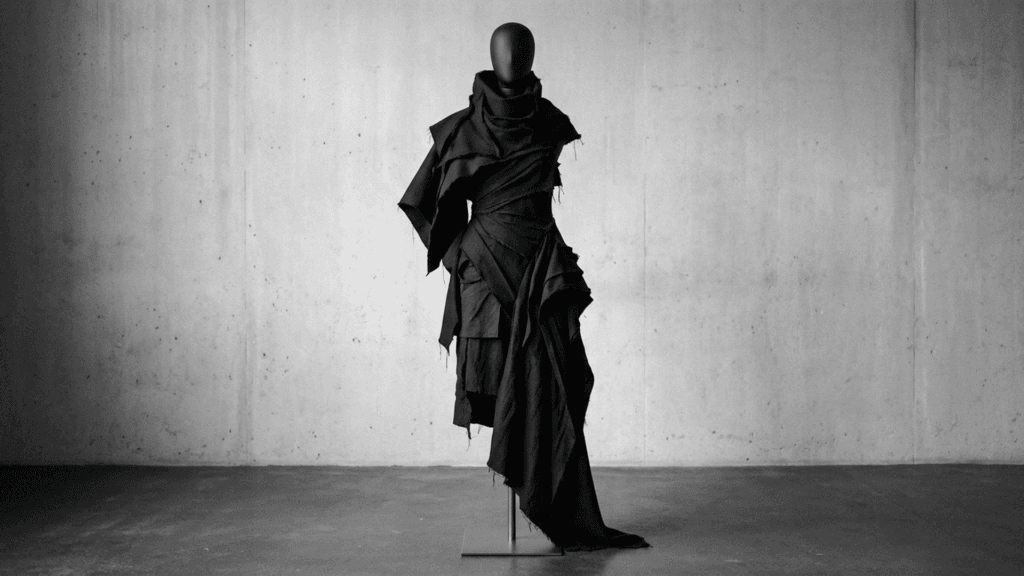
Few names in fashion carry the weight of Comme des Garçons, and fewer still have changed what clothing is allowed to be. The Japanese house, founded by Rei Kawakubo in Tokyo in 1969, did not simply add to the vocabulary of fashion; it questioned the grammar itself, treating garments as ideas rather than decoration and turning the runway into a place where those ideas were argued in public. From its explosive Paris debut in 1981 to its collaborations with Converse and Nike, the brand has built a following that waits for each collection the way audiences wait for an artist’s next work. This guide explains the house’s history, the vision behind it, the shows that defined it, and the collaborations that carried it into everyday life.
The Origins: Rei Kawakubo and the Birth of the House
The story of Comme des Garçons begins with a designer who never formally trained as one, and that outsider status shaped everything that followed.
Rei Kawakubo founded the label in Tokyo in 1969, having studied fine art and worked as a stylist before deciding to make clothes herself. The name, French for “like some boys,” was borrowed from a Françoise Hardy song and carried a deliberate ambiguity, a refusal to be pinned down that became the house’s signature. From the beginning, Kawakubo approached clothing as a form of expression rather than adornment, and the early collections, dominated by black, asymmetry, and unfinished edges, established a vocabulary that the rest of the industry would spend decades absorbing.
What distinguished Kawakubo was that she treated fashion as a conceptual practice. Where other designers refined what clothing looked like, she questioned what clothing was for, why a seam must be straight, why a garment must flatter, why a silhouette must follow the body. Those questions, asked consistently over five decades, produced a body of work that is closer to sculpture and philosophy than to seasonal fashion, and they made the house a reference point far beyond its own runway.
The Paris Debut and the Shock of the New
The moment that announced Comme des Garçons to the world is one of the defining events in modern fashion history, and it deserves its place in the story.
In 1981, Kawakubo showed in Paris for the first time, presenting clothing that the European establishment found almost incomprehensible: black, draped, frayed, and deliberately imperfect garments that seemed to reject everything the fashion system valued. The reaction was hostile from some quarters and rapturous from others, but the effect was immediate. The show introduced the Western fashion world to the Japanese avant-garde, alongside Yohji Yamamoto, and it permanently expanded the definition of what fashion could look like.
The term that came to attach to the work was deconstruction. Kawakubo’s clothes exposed their own construction, with raw seams, deliberate asymmetry, and shapes that enveloped rather than revealed the body. This was not sloppiness but a philosophy: the garment did not exist to decorate the wearer but to enter a conversation with them. That idea, radical in 1981, has since become one of the central currents of contemporary fashion, absorbed everywhere from luxury houses to streetwear.
The Fashion Shows as Art
One of the reasons Comme des Garçons builds such a devoted following is that its fashion shows are treated as complete artistic statements rather than product presentations, and the audience understands the difference.
Kawakubo’s collections are rarely about a single garment and almost always about an idea, expressed across an entire show. The Spring/Summer 1997 collection, known as “Body Meets Dress, Dress Meets Body” and often called the “lumps and bumps” collection, is the most famous example: garments padded with down into misshapen protrusions that distorted the human silhouette, challenging the assumption that clothing should flatter the figure. It was widely misunderstood at the time and is now regarded as one of the most influential collections ever shown.
This approach extends beyond the clothes to the presentation itself. The shows are staged with a deliberate, almost theatrical austerity, and the models move in ways that are choreographed rather than merely walked. The cumulative effect is that a Comme des Garçons show is an event in the way a gallery opening or a premiere is an event, and the people who attend are participating in something they believe matters. That belief, sustained across decades, is a large part of what makes the house’s following so loyal.
The Recognition of the Art World
The blurring of fashion and art that Kawakubo practised for decades was eventually acknowledged by the institutions of art themselves, and the acknowledgement completed a circle.
In 2017, the Metropolitan Museum of Art’s Costume Institute devoted its major annual exhibition to Kawakubo, with the show “Rei Kawakubo/Comme des Garçons: Art of the In-Between.” It was only the second time the Costume Institute had honoured a living designer with a solo exhibition, and the title captured exactly what the house had been doing all along: operating in the space between categories, between fashion and art, between garment and sculpture, between east and west.
The exhibition mattered because it translated decades of runway work into the language of the museum, making the case that the clothing was always intended to be read as seriously as any other art form. For the house’s followers, it was a public confirmation of what they had always believed, and it cemented Kawakubo’s place not just in fashion history but in the broader history of design.
The Play Line and the Heart That Went Everywhere
For all its conceptual radicalism, Comme des Garçons also produced one of the most commercially successful motifs in fashion, and the contrast is itself part of the house’s story.
The Play line, launched in the early 2000s, took a simple illustration, a heart with two eyes drawn by the Polish artist Filip Pagowski, and applied it to t-shirts, knitwear, and casual pieces. The heart-with-eyes logo became instantly recognisable, and the Play line became the entry point through which millions of people first encountered the brand. Where the main collections were exclusive and expensive, Play offered a piece of the Comme des Garçons world at an accessible price, and it succeeded beyond anything the house could have predicted.
The genius of Play is that it did not dilute the brand but expanded it. The heart logo carried a whisper of the house’s playfulness and oddity into the mainstream, and it became a kind of secret handshake, a way for people who knew nothing of “lumps and bumps” to still claim a connection to one of fashion’s most radical houses. It is the rare example of a luxury brand extending downward without losing its soul.
The Collaborations That Built a Following
The collaborations are the other engine of the house’s popularity, and they reveal a strategic intelligence that sits alongside the conceptual daring.
The most famous collaboration is with Converse. The Comme des Garçons Play x Converse Chuck Taylor, with the heart logo on a classic canvas sneaker, became one of the most recognisable shoes of its era, worn everywhere from fashion weeks to school hallways. It is the perfect collaboration because it joins two iconic shapes, the Chuck and the heart, into something that feels inevitable in retrospect.
Beyond Converse, the house has collaborated across a remarkable range: with Nike on a series of sneaker releases, with artists, with other designers, and through Dover Street Market, the retail concept Kawakubo created to house these collaborations and the broader avant-garde. Each collaboration works on the same principle: take an iconic object, apply the Comme des Garçons sensibility, and produce something that is both instantly familiar and subtly strange. The result is a stream of releases that gives followers a reason to pay attention between collections, which is precisely how a fashion house builds and keeps a loyal following.
The Philosophy That Holds It Together
What makes all of this cohere, the runway provocation, the museum recognition, the mass-market heart, the sneaker collaborations, is a consistent philosophy, and it is worth naming.
Kawakubo’s work is built on the refusal of easy answers. She has never been interested in making clothing that simply looks nice, and she has never followed the seasonal logic that governs most of the industry. Instead, she has treated each collection as a question, posed in fabric: what is a garment, what is a body, what is beautiful, what is new. The answers are deliberately incomplete, and that incompleteness is the invitation.
This is why the house’s followers describe their loyalty in terms that go beyond fashion. They are not buying a seasonal look; they are following a body of thought expressed in cloth, and each new collection is the next chapter. That relationship, between a designer’s ideas and an audience that takes them seriously, is the deepest source of the brand’s enduring power.
Conclusion
In conclusion, Comme des Garçons endures because it gave fashion something it rarely has: a genuine intellectual project. From Rei Kawakubo’s Tokyo beginnings through the 1981 Paris shock, the deconstructive collections, the museum recognition, and the heart logo that reached the world, the house has stayed faithful to its founding questions while finding new ways to ask them. Its fashion shows remain events, its collaborations remain cultural moments, and its following remains loyal because it is following ideas, not seasons. The house’s French name still refuses to resolve into a single meaning, and that is exactly the point. Comme des Garçons is not a brand that tells you what to wear; it is a conversation that has been going on for more than fifty years, and everyone is still listening.
Frequently Asked Questions
1. What does Comme des Garçons mean?
The name is French for “like some boys,” borrowed from a Françoise Hardy song, and it was chosen by founder Rei Kawakubo for its deliberate ambiguity.
2. Who founded Comme des Garçons?
Rei Kawakubo founded the label in Tokyo in 1969, after studying fine art and working as a stylist rather than training formally as a designer.
3. What is the Comme des Garçons Play line?
Play is the accessible casual line featuring the heart-with-eyes logo drawn by artist Filip Pagowski, known for t-shirts, knitwear, and the Converse collaboration.
4. What is Comme des Garçons known for?
The house is known for avant-garde, deconstructed clothing, predominantly in black, that challenges conventional ideas of beauty, form, and the body.
5. When did Comme des Garçons first show in Paris?
The house made its Paris debut in 1981, a show that shocked the European fashion establishment and introduced the Japanese avant-garde to the world.
6. What is the “lumps and bumps” collection?
The Spring/Summer 1997 collection, “Body Meets Dress, Dress Meets Body,” used padding to distort the silhouette, and it is now considered one of the most influential collections in fashion history.
