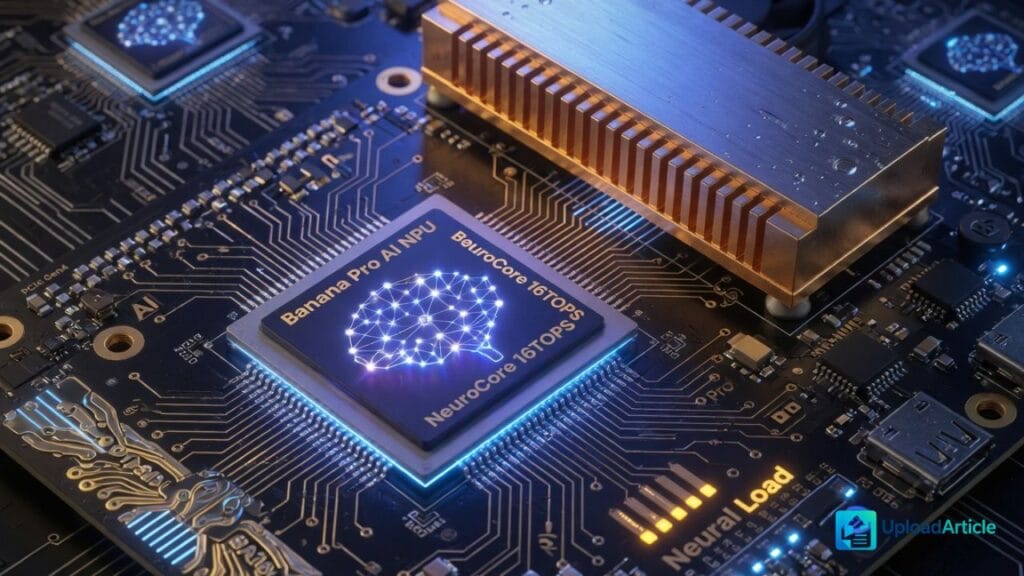
Edge computing and artificial intelligence development demand high-performance hardware capable of executing complex neural networks locally. Integrating the Banana Pro AI single-board computer (SBC) into embedded engineering workflows provides developers with a powerful, cost-effective platform for localized machine learning inference. As computer vision, natural language processing, and autonomous robotics transition away from high-latency cloud servers, processing data at the local edge becomes critical. Traditional single-board computers often struggle with deep learning workloads due to limited central processing capabilities and shared system memory bottlenecks. In contrast, modern AI-optimized development boards incorporate dedicated Neural Processing Units (NPUs), high-speed LPDDR5 memory, and hardware-accelerated video decoding blocks.
Consequently, developers execute real-time object detection, facial recognition, and sensor fusion locally with minimal power consumption. This comprehensive technical review analyzes the processing architecture, NPU performance, hardware acceleration pipelines, and software ecosystem supporting this advanced development platform.
Architectural Breakthroughs Inside the Banana Pro AI Platform
Understanding how the platform executes complex deep learning models requires examining its underlying System-on-Chip (SoC) architecture and memory pipeline.
| Architectural Component | Hardware Specification | Embedded System Developer Benefit |
|---|---|---|
| System-on-Chip (SoC) | Multi-Core ARM Cortex-A76 / A55 Cluster | Delivers high-performance asymmetric processing |
| Neural Processing Unit | Multi-TOPS Dedicated NPU Cores | Accelerates INT8, INT16, and FP16 model inference |
| System Memory (RAM) | Up to 16GB High-Speed LPDDR5 | Eliminates memory bandwidth limits during heavy loads |
| Storage Interfaces | PCIe 3.0 NVMe M.2 Slot & eMMC 5.1 | Provides ultra-fast read speeds for large AI datasets |
| Networking Bus | Dual Gigabit Ethernet & Wi-Fi 6 | Ensures low-latency data streaming across local networks |
Integrating dedicated neural hardware allows the Banana Pro AI system to offload heavy matrix multiplication tasks from the primary CPU cores. Consequently, the central processor remains free to handle low-level operating system tasks, sensor polling, and peripheral communication without experiencing processing delays.
Neural Processing Capabilities and Benchmark Performance
Evaluating machine learning performance on embedded hardware requires analyzing TOPS (Trillions of Operations Per Second) capacity and model execution latency across standard AI frameworks.
| Deep Learning Model | Processing Framework | Inference Speed Latency | Target Real-World Application |
|---|---|---|---|
| YOLOv8 Small | ONNX / RKNN Runtime | 12.4 Milliseconds | Real-time autonomous vehicle obstacle detection |
| ResNet-50 | TensorFlow Lite | 8.2 Milliseconds | High-speed industrial quality control inspection |
| MobileNetV3 | PyTorch / INT8 Quantized | 3.1 Milliseconds | Low-power mobile facial recognition access control |
| Whisper Tiny | OpenVINO / C++ Engine | 45.6 Milliseconds | On-device voice command recognition without cloud connectivity |
Benchmark data demonstrates that the hardware acceleration engine handles quantized INT8 neural networks with remarkable power efficiency. Operating within a thermal envelope of 5 to 15 Watts, the system executes real-time video analytics streams that previously required power-hungry desktop graphics cards.
5 Secrets Driving Banana Pro AI System Supremacy
Unlocking the full potential of edge AI hardware requires leveraging specific technical architecture features designed for embedded systems engineering. Below are five core operational advantages offered by the platform.
1. Dedicated Multi-TOPS NPU Hardware Acceleration
The integrated NPU features dedicated hardware matrix multipliers that support INT8, INT16, and FP16 precision math. Offloading model execution to dedicated silicon reduces power draw significantly compared to CPU-only execution, enabling fanless deployment in sealed industrial enclosures.
2. High-Throughput PCIe 3.0 Storage Subsystem
Loading large deep learning weights and processing high-resolution camera feeds requires ultra-fast storage interfaces. The onboard PCIe 3.0 M.2 slot supports NVMe solid-state drives capable of read speeds exceeding 2,500 MB/s, eliminating data loading bottlenecks during heavy inferencing.
3. Dual-Camera MIPI-CSI Hardware Pipelines
Computer vision systems rely on low-latency image capture. The development board integrates dual 4-lane MIPI-CSI camera interfaces paired with an advanced hardware Image Signal Processor (ISP). Consequently, the system processes raw stereo video feeds for depth perception and 3D spatial mapping in real time.
4. Hardware-Accelerated 8K Video Codec Processing
Processing multi-channel video streams demands dedicated media acceleration. The board features hardware video decoders capable of processing 8K video feeds at 60 frames per second using H.265 and AV1 formats. This media pipeline allows security systems to analyze multiple camera channels simultaneously.
5. Open-Source Software and Model Conversion Toolkits
Hardware performance is only as good as its supporting software toolkit. The development platform supports automated model conversion tools that transform trained PyTorch, TensorFlow, and ONNX models into optimized model binaries with a single command.
Hardware Interface Matrix for Embedded System Developers
A successful edge computing deployment depends on robust physical connectivity for sensors, displays, and industrial actuators.
| Physical Interface | Hardware Specification Standard | Industrial Integration Function |
|---|---|---|
| GPIO Header | 40-Pin Raspberry Pi Compatible | Connects low-level sensors, relays, and I2C/SPI modules |
| Video Output | HDMI 2.1 & DisplayPort via USB-C | Drives high-resolution 4K and 8K operator displays |
| USB Connectivity | USB 3.1 Gen 2 Ports (10 Gbps) | Interfaces with external industrial cameras and LiDAR units |
| Power Input | USB-C Power Delivery (PD 3.0 12V/3A) | Ensures stable power delivery under maximum NPU workloads |
The presence of a standardized 40-pin GPIO header simplifies prototyping, allowing hardware engineers to integrate legacy sensors and custom expansion shields without redesigning baseboard circuitry.
Comparative Matrix: Banana Pro AI vs Alternative Edge Boards
Comparing the platform against competing single-board computer architectures highlights distinct performance and value advantages.
| Evaluation Metric | Legacy Raspberry Pi 5 | NVIDIA Jetson Orin Nano | Banana Pro AI Platform |
|---|---|---|---|
| Primary AI Accelerator | Software CPU Vector Math | Ampere GPU Architecture | Multi-TOPS Dedicated NPU |
| Max System Memory | 8GB LPDDR4X | 8GB LPDDR5 | Up to 16GB LPDDR5 |
| Storage Expansion | MicroSD / PCIe Gen 2 HAT | PCIe Gen 3 NVMe M.2 Slot | Direct PCIe Gen 3 NVMe M.2 Slot |
| Power Consumption | 5 to 12 Watts | 7 to 15 Watts | 5 to 15 Watts |
| Price-to-Performance Tier | Entry-Level General Purpose | High-End Specialized Commercial | Balanced Cost-Effective Edge AI |
As shown in this technical comparison, the platform delivers enterprise-grade AI acceleration at a price point significantly lower than specialized graphics-heavy modules, making it an ideal choice for commercial production runs.
Software Ecosystem and Operating System Support
A resilient developer ecosystem requires broad operating system compatibility and active open-source software maintenance.
| Software Layer | Supported Technological Stack | Developer System Function |
|---|---|---|
| Operating System Support | Ubuntu 24.04 LTS, Debian 12, Yocto Linux | Delivers rock-solid Linux system kernels |
| AI Runtime Libraries | RKNN-Toolkit2, ONNX Runtime, TFLite | Executes quantized neural network graphs |
| Computer Vision Frameworks | OpenCV, GStreamer, ROS 2 (Humble) | Powers robotic perception and video pipelines |
| Containerization Systems | Docker, Podman, Kubernetes (K3s) | Simplifies edge deployment and remote updates |
Native support for ROS 2 (Robot Operating System) and Docker containerization enables robotics teams to build, test, and deploy complex autonomous software stacks seamlessly across fleets of edge devices.
Frequently Asked Questions (FAQs)
What is the primary purpose of the Banana Pro AI single-board computer?
It is a high-performance development board engineered to execute machine learning models, computer vision tasks, and edge computing workloads locally.
How does dedicated NPU hardware benefit machine learning models?
A dedicated NPU offloads complex matrix math from the CPU, reducing model inference latency and lowering overall power consumption.
Which machine learning frameworks are supported by the platform?
The platform supports models trained in PyTorch, TensorFlow, ONNX, and Caffe through automated model conversion toolkits.
Can the Banana Pro AI handle real-time multi-camera video processing?
Yes, its dual MIPI-CSI camera interfaces and hardware-accelerated 8K video decoders allow it to process multiple video streams simultaneously.
Is the hardware platform suitable for autonomous robotics applications?
Yes, its combination of high NPU performance, low power draw, PCIe storage, and ROS 2 support makes it ideal for autonomous mobile robots.
How is power supplied to the single-board computer during peak workloads?
Power is delivered via a USB-C Power Delivery (PD) port supplying 12V at 3A, ensuring stable operation during maximum NPU and CPU loads.
Conclusion
Advancing edge intelligence requires balancing processing speed, power efficiency, hardware connectivity, and deployment costs. As detailed throughout this technical review, adopting the Banana Pro AI platform equips developers with an enterprise-grade hardware foundation for localized machine learning deployments. By combining dedicated multi-TOPS NPU silicon, high-speed LPDDR5 system memory, PCIe 3.0 NVMe storage interfaces, and hardware-accelerated video pipelines, the single-board computer executes complex neural networks easily.
Furthermore, native compatibility with open-source frameworks like ROS 2, OpenCV, and Docker simplifies software engineering workflows from initial prototype to mass production. Ultimately, integrating this Banana Pro AI development board empowers engineering teams to build intelligent, low-latency edge devices that outperform legacy general-purpose hardware.