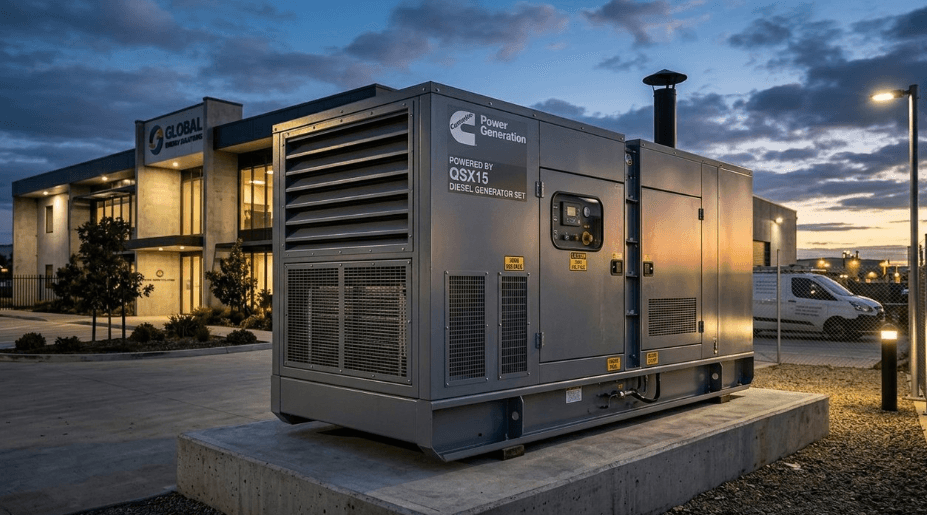
Power rarely fails on schedule, and when it does, every minute without electricity costs money. A diesel generator closes that gap, starting up the moment the grid drops and carrying the full load until power returns. Teksan builds these sets from 9 to 2800 kVA, with or without cabins, to cover everything from a small shop to a large industrial plant. Here is what to know before you buy.
What Is a Diesel Generator?
A diesel generator is a machine that converts the chemical energy in diesel fuel into electricity. It pairs a diesel engine with an alternator, working as a complete set. When the engine burns fuel, it drives the alternator, which produces the electrical current that powers your equipment.
Teksan produces diesel generator sets in a standard portfolio ranging from 9 to 4500 kVA, with engines from leading manufacturers including Baudouin, Cummins, Doosan, Perkins, Hyundai, and Mitsubishi. The company has built its reputation on low operating costs, longevity, and consistent performance across sectors.
How a Diesel Generator Works
The process is straightforward. Diesel fuel is injected into the engine and ignited by compression, which pushes the pistons and creates motion. The engine transfers that motion to the alternator, which converts it into electricity. Because there is no spark plug involved, the design is simpler and more durable than gasoline equivalents.
Why Diesel Remains the Standard
Diesel sets stay popular for good reason. They start quickly, handle heavy loads reliably, and run for long periods without interruption. Unlike solar or wind, they do not depend on the weather, which makes them the dependable choice for hospitals, data centers, factories, and mines.
Teksan Diesel Generator Power Range
The right set depends on what you need to power, and Teksan covers a broad spectrum.
Small and Mid-Range Units
Diesel Generator Sets for Shops and Homes
Compact sets in the 9 to 45 kVA range suit small businesses, homes, and telecom sites. They deliver enough power for essential equipment without the footprint of a large industrial unit.
Diesel Generator Sets for Commercial Buildings
Mid-range units from 46 to 300 kVA serve offices, retail spaces, and mid-size facilities. They balance capacity with fuel efficiency, keeping operating costs in check.
Large Industrial Units
Diesel Generator Sets for Heavy Industry
From 500 kVA up to 4500 kVA, these sets power factories, data centers, mining operations, and large infrastructure projects. They are engineered for continuous duty and high-load performance.
Cabin Options
Teksan offers both open and canopied designs. Cabin models provide weather protection and sound insulation, while open sets suit installations in dedicated generator rooms.
What Sets Teksan Diesel Generator Sets Apart
Several design choices distinguish Teksan from the broader market.
Fuel Savings Through R&D
Teksan’s engineering work delivers up to 10 percent fuel savings on select models. Over the life of a generator, that reduction adds up to meaningful operating cost savings.
Super-Silent Canopy Design
The new canopies use Tashfoam insulation to reach a sound level of 60 dBA at one meter. That is quiet enough for urban and residential settings where noise is a concern.
Full First-Step Load Handling
Teksan sets accept the entire first-step load at once when power fails. This means motors, compressors, and pumps start reliably without tripping the unit.
Proven Durability
Robotic paint shops apply finishes that withstand more than 3000 hours of salt-spray testing, so the units keep their appearance and integrity for years in harsh environments.
Choosing the Right Diesel Generator
Selecting the correct unit means matching the set to your actual power demand and application.
Understand Standby vs Prime Power
Standby sets run only during outages, while prime power sets run continuously as the main source. The rating you need determines the model and sizing.
Calculate Your Load
Add up the wattage of everything you need to power, including startup surges from motors. Oversizing slightly protects against future growth and peak loads.
Consider Noise and Location
If the unit sits near homes or offices, choose a super-silent canopy. For remote industrial sites, an open set may be more cost-effective.
Factor in Maintenance
Longer service intervals reduce downtime and cost. Teksan designs its sets for extended maintenance periods, which keeps the total cost of ownership low.
Real-Time Market Context
Demand for diesel generators continues to climb as grids face more frequent outages and industries expand. Industry research from MarketsandMarkets values the global diesel generator market at about $19.26 billion in 2026, projected to reach $25.61 billion by 2031 at a 5.9 percent compound annual growth rate. Other estimates range from roughly $22 billion to $27 billion in 2026 depending on methodology.
Growth is driven by data centers, healthcare facilities, telecom infrastructure, construction, and mining, especially in regions with unreliable grid supply. Extreme weather is another factor, as hurricanes, wildfires, and winter storms push facility owners to strengthen backup power. Asia-Pacific leads the market with over 39 percent share, while residential adoption grows fastest in North America.
Where Diesel Generators Are Essential
Data Centers and Healthcare
These facilities cannot tolerate even a moment of downtime, making reliable diesel backup a non-negotiable investment.
Construction and Mining
Remote sites without grid access depend on diesel generators for both prime and standby power.
Commercial and Industrial Facilities
Factories, offices, and retail centers use diesel generators to protect operations and avoid costly interruptions.
Maintaining a Diesel Generator
A diesel generator lasts for decades when properly maintained. Routine care is simple but essential.
Regular Checks
Monitor battery charge, engine coolant level, and engine oil level. Check for oil leaks and confirm the fuel tank holds enough diesel for the expected runtime.
Scheduled Servicing
Follow the manufacturer’s service schedule for oil changes, filter replacement, and belt checks. Longer maintenance intervals reduce downtime, but skipped service shortens engine life.
Load Testing
Run the generator under load periodically to confirm it starts and carries the rated output. A set that sits idle can develop fuel and starting problems.
Frequently Asked Questions
What is a diesel generator?
A diesel generator is a set that combines a diesel engine and an alternator to convert fuel into electrical energy for backup or continuous power.
How does a diesel generator work?
The engine burns diesel fuel to create motion, which drives the alternator, and the alternator converts that motion into usable electricity.
What power range is available for diesel generator sets?
Teksan offers standard diesel generator sets from 9 kVA to 4500 kVA, with customized options available for specific project requirements.
What is the difference between standby and prime power?
Standby sets run only during outages, while prime power sets operate continuously as the main power source for off-grid sites.
How often should a diesel generator be maintained?
Routine checks of battery, coolant, and oil levels should be frequent, with full servicing performed according to the manufacturer’s schedule.
Are silent diesel generators available?
Yes, Teksan’s super-silent canopies use Tashfoam insulation to achieve 60 dBA at one meter, suitable for noise-sensitive locations.
Conclusion
A diesel generator remains one of the most dependable ways to keep power flowing when the grid does not. From a 9 kVA unit for a small shop to a 4500 kVA set for heavy industry, the right diesel generator protects operations, safeguards equipment, and pays for itself during the first extended outage. As the market grows toward $25 billion by 2031 on the strength of data centers, mining, and extreme weather, choosing a well-engineered set matters more than ever. Look for fuel efficiency, quiet operation, full load handling, and proven durability, and you will have backup power you can count on for decades.