The factory lock on most RVs is one of the least impressive parts of the vehicle, a basic keyed latch that does the minimum asked of it and not much more. For owners who live and travel in their rigs, that minimum is rarely enough, and the upgrade to better RV door locks has become one of the most common improvements a camper owner makes. The modern options, keyless entry with keypads and remote fobs, change how the whole RV experience works, and understanding the category is the first step to choosing right. This guide explains the types of RV locks, the features that matter, what to check before buying, and how ONNAIS’s Guard Series fits into the picture.
Why the Factory Lock Falls Short
To understand the upgrade, it helps to understand what the standard RV lock does, and why owners so often replace it.
Most travel trailers and campers ship with a basic keyed door lock, and the limitations are practical rather than theoretical. The first is key dependence: the key must be carried, kept track of, and produced every time the door is opened, which is a small friction that adds up over a camping trip of a hundred small errands. The second is shared keys: many RV locks use common key codes, which means the lock on one trailer may be opened by the key from another, a security reality that most owners discover with discomfort.
The third is durability. RV doors flex and shake through travel, and the standard lock mechanisms wear under that movement, becoming stiff, loose, or unreliable over time. For a vehicle that is a home on the road, these limitations are enough to justify the upgrade, and the aftermarket has responded with a category of locks built specifically for the rigors of RV life.
The Types of RV Door Locks
The category breaks down into a few clear types, and the progression tells the story of the market.
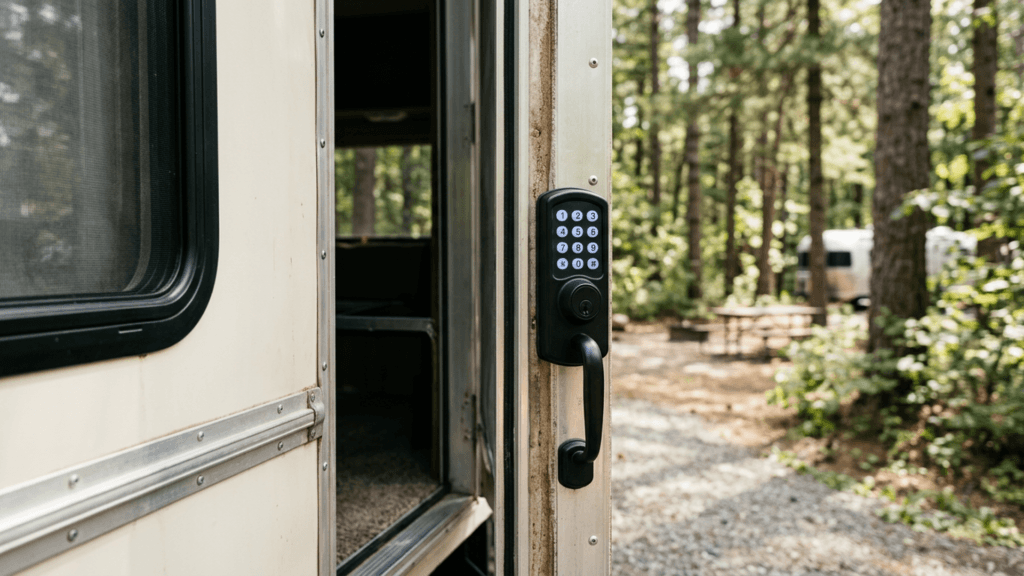
The keyed lock is the original, a standard latch-and-deadbolt operated by a physical key, and it remains the baseline against which everything else is measured. The keypad lock adds an electronic keypad, so the door can be opened with a code rather than a key, which removes the key-dependence problem while keeping a mechanical key as backup. The remote fob lock goes a step further, adding a wireless fob so the door can be locked or unlocked at a distance, which is a convenience that matters when your hands are full of firewood or groceries.
The current top of the category combines all three: keypad entry, remote fobs, and a mechanical backup key, so the owner has every method available and no single point of failure. This is the design the ONNAIS Guard Series follows, and it reflects what the market has settled on as the right combination of convenience and reliability.
The Features That Matter
The differences between RV locks are in the details, and a few features are worth understanding before you buy.
Weather resistance is the first, because an RV lock lives outdoors in conditions that would destroy an indoor lock. A lock rated for waterproof, weather-resistant construction is the baseline for anything mounted on an RV door. The keypad should be backlit for use after dark, because campsite arrivals rarely happen in daylight, and the buttons should be durable enough for gloved or dirty hands.
The remote fob is the second feature, and its range and reliability matter more than its existence, because a fob that works only from a few feet away is a convenience rather than a solution. Dual-fob packages are standard on the better locks, and some allow a single fob to control two locks, which suits owners with multiple access points.
The backup is the third. A keyless lock must still have a mechanical key, because electronics can fail, and a lock with no physical fallback can lock the owner out of their own home on the road. The best designs treat the electronic entry as the convenience and the mechanical key as the guarantee, which is exactly the right hierarchy.
The ONNAIS Guard Series
For owners shopping the category, the ONNAIS Guard Series is a representative example of the modern keyless RV lock, and it is worth describing concretely.
The series offers two main models. The Guard SE is the essential option, with keyless entry, a waterproof design, and dual remote fobs, priced from $149.99, and it holds a 4.67 rating from 153 reviews at the time of writing. The Guard Pro is the step up, with the same keyless entry and waterproof construction plus additional features, priced from $169.99, with a 4.64 rating from 145 reviews. A refurbished Guard SE is also available for owners who want the keyless upgrade at a lower entry price.
Both models are built for the conditions of RV life: keypad access, remote fobs, mechanical backup keys, and weather-resistant construction, and they fit standard right-hinged doors on travel trailers and campers, pairing with an existing camper keypad for layered protection. The locks are marketed with the tagline that frames the appeal neatly: lock in freedom, lock out worry.
What to Check Before You Buy
The single most common mistake in buying an RV lock is a fitment error, and it is avoidable with a few checks.
The first check is the door’s hinge side. Most aftermarket RV locks are designed for right-hinged doors, and installing one on a left-hinged door may leave it misaligned or non-functional, so confirm the hinge orientation before ordering. The second check is the cutout dimensions, because RV doors vary, and the lock’s mounting requirements must match the existing door prep or the installation will involve modification.
The third check is the power source, because electronic locks run on batteries, and knowing the battery type and expected life is part of owning one. The fourth is the backup, which should be a mechanical key in every serious design. And the fifth is the review record, because a lock’s real-world reliability shows up in owner reports of weather performance, fob range, and durability over travel.
Installation and the Upgrade Path
Installing an RV door lock is a realistic project for a competent owner, and it is part of why the upgrade is so popular.
The typical installation replaces the existing lock mechanism using the same door cutout, and the process involves removing the old lock, fitting the new assembly, and connecting the keypad and electronics, work that most owners complete with basic tools in under an hour. The mechanical backup key is cut or programmed at the same time, and the keypad code and fobs are set up to the owner’s preferences.
For anyone unsure about the fit or the wiring, the sensible path is to confirm the model’s compatibility before buying and to follow the manufacturer’s installation guide, because a misaligned RV lock is worse than the factory lock it replaced. Done correctly, the upgrade is one of the highest-satisfaction improvements an RV owner can make, because it changes an interaction that happens dozens of times a day.
Why Keyless Entry Transforms RV Life
The appeal of the upgrade is best understood through the daily reality of RV travel, because the benefits are cumulative rather than dramatic.
The keyless lock removes the constant key management that RV life otherwise requires, the pocket check before every walk, the key handoff between family members, the fumbling at the door with hands full. The fob adds the convenience of locking or unlocking from a distance, which matters when approaching with gear or checking that the door is secure from across the campsite. And the code entry means the family can share access without sharing keys.
Security improves in the process, because the lock is no longer subject to the shared-key vulnerability of the factory unit, and the weather-resistant construction means the lock keeps working through the conditions that wore out the original. For an owner, the summary is simple: the same money spent on a cosmetic upgrade delivers less than a keyless lock does, because the lock is touched every single time the RV is used.
Conclusion
In conclusion, RV door locks have evolved from a forgettable factory component into one of the most satisfying upgrades an owner can make, and the modern keyless designs are the reason. The combination of keypad entry, remote fobs, and a mechanical backup removes the friction of key management, adds a layer of security, and is built to survive the weather and vibration that killed the original lock. The buying decision comes down to fitment, the hinge side and cutout, and the features, weather resistance, fob reliability, and backup key, and the ONNAIS Guard Series, with its SE and Pro models, represents the category’s current standard. For an RV owner, the upgrade is one of the few purchases that improves the experience of the vehicle every single day, and that is exactly what the best RV door locks are built to do.
Frequently Asked Questions
1. What types of RV door locks are available?
RV locks range from standard keyed locks to keypad entry locks and keyless locks with remote fobs, with the best combining all three plus a mechanical backup key.
2. Are keyless RV door locks weatherproof?
The better models are built with waterproof, weather-resistant construction designed for outdoor exposure on an RV door.
3. Do keyless RV locks work with a backup key?
Yes, quality keyless locks include a mechanical backup key so the door can still be opened if the electronics or battery fail.
4. How do I know if an RV lock will fit my door?
Confirm the door’s hinge side, because most aftermarket locks fit right-hinged doors, and check the lock’s cutout dimensions against your door.
5. How much do keyless RV door locks cost?
ONNAIS’s Guard SE starts from $149.99 and the Guard Pro from $169.99, with a refurbished SE available at a lower price.
6. Are RV door locks hard to install?
Most replace the existing lock through the same door cutout and can be installed with basic tools, typically in under an hour.