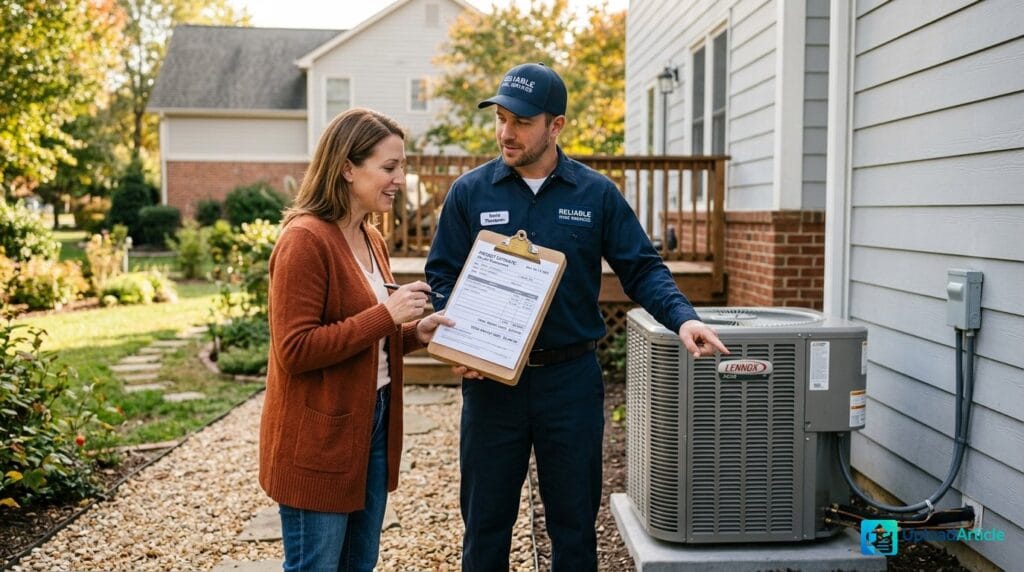
Most people spend more time researching a restaurant for dinner than they spend qualifying the contractor who will install a five-figure cooling system in their home.
That asymmetry, hours of deliberation over a meal that costs eighty dollars and thirty minutes of conversation before signing a contract worth eight thousand, is the reason so many homeowners end up with systems that are the wrong size, wired incorrectly, paired with leaky ductwork, and covered by warranties that evaporate the moment the installer’s truck leaves the driveway. Hiring the wrong air conditioning company costs far more than hiring the right one ever could.
A competent air conditioning company can answer every question in this guide without hesitation, without defensiveness, and without trying to change the subject to monthly payment amounts. An air conditioning company that welcomes scrutiny is demonstrating confidence in its work before a single dollar changes hands. An air conditioning company that cannot, or will not, is telling you something you need to hear before signing anything.
The difference between the two determines whether the next decade of summers is comfortable or frustrating, whether your energy bills reflect efficient operation or systemic waste, and whether you call the same air conditioning company for maintenance or spend your evenings leaving negative reviews while waiting for a different contractor to fix what the first one botched.
This guide walks through the eight questions that separate the air conditioning company you should hire from the one you will wish you had never met. Each question exists because enough homeowners hired the wrong air conditioning company that the industry now has standardized warnings about what happens when you do not ask. Each question exists because enough homeowners learned the answer the hard way that the industry now has standardized warnings about what happens when you do not ask.
The Question That Exposes Everything in the First Five Minutes
Before discussing equipment brands, efficiency ratings, or installation timelines, there is one question that reveals more about an air conditioning company than everything that follows. Any air conditioning company worthy of your business can answer it immediately.
What happens if I am not satisfied with the system after it is installed?
A legitimate air conditioning company answers this question with a specific process. The system gets evaluated against the performance standards established in the contract. If it fails to meet those standards, the company returns, diagnoses the issue, corrects it at no additional charge, and remains responsible until the system performs as promised. Some air conditioning companies offer money-back or comfort guarantees that put the risk of underperformance on the contractor rather than the homeowner.
An air conditioning company that hedges on this question, that offers vague assurances instead of specific commitments, or that changes the subject to manufacturer warranties is communicating something unambiguous. An air conditioning company that cannot guarantee its own installation does not deserve the opportunity to perform it. The company is not confident in its installation quality. If the installer does not trust its own work enough to guarantee it, there is no reason the homeowner should trust it either.
This question should be asked first, before any discussion of pricing or scheduling, because the answer tells you whether the conversation that follows is worth having at all.
Why the Size of Your System Matters More Than Its Price
The single most common mistake in residential cooling installations, and the one that separates a competent air conditioning company from an order-taker, is incorrect equipment sizing.
An oversized system cools the space too quickly without running long enough to remove humidity, leaving the home cold but clammy. An undersized system runs continuously without ever reaching the set temperature, consuming electricity around the clock while failing to deliver comfort. Both scenarios produce the same result: an expensive installation that does not perform.
A qualified air conditioning company determines the correct system size through a Manual J load calculation, which measures every room in the home and accounts for square footage, insulation values, window orientation and efficiency, air leakage rates, ceiling height, and the local climate. This calculation produces a specific number, expressed in tons or BTUs, that represents the actual cooling load the system must handle.
An air conditioning company that proposes replacing an existing system with the same size without performing a new load calculation is skipping the single most important step in the installation process. An air conditioning company that guesses instead of calculates is not doing the job you are paying for. The previous system may have been sized incorrectly from the start. The home may have been renovated, reinsulated, or had windows replaced since the original installation. Assuming that what was there before is correct is not engineering. It is guessing, and guessing is what a good air conditioning company is paid to eliminate.
Ask whether a Manual J load calculation will be performed. Ask to see the results. If the air conditioning company cannot produce them, find an air conditioning company that can, because the one you are talking to is not qualified to size your system.
The License, Insurance, and Permit Problem Nobody Discusses
The HVAC industry operates under a regulatory structure that varies by state and municipality, and the homeowner who assumes that every air conditioning company operating in the area is properly licensed is assuming something that is not always true. An air conditioning company without a current license has no legal authority to perform the work.
A legitimate air conditioning company holds a current state HVAC contractor license, carries general liability insurance, maintains workers compensation coverage, and pulls the permits required by the local building department before starting work. An air conditioning company that meets all four criteria is operating legally. An air conditioning company that does not is exposing the homeowner to liability that insurance will not cover, and that exposure is not worth whatever discount persuaded you to accept it.
Permits matter because they trigger an independent inspection by a municipal code enforcement officer who verifies that the installation meets current safety and efficiency standards. An air conditioning company that suggests skipping permits to save time or money is asking the homeowner to accept legal and financial liability for work that may not meet code, that may create safety hazards, and that may need to be ripped out and redone if discovered during a future home sale inspection.
Verify the license number through the state licensing board’s online database. Confirm that the name on the license matches the air conditioning company on the contract. Ask to see the certificate of insurance, and verify that the policy is current. An air conditioning company that hesitates at any of these requests has something to hide. These steps take ten minutes. The problems they prevent can take years and tens of thousands of dollars to resolve.
What Your Quote Is Quietly Leaving Out
The number on a written estimate is not the problem. The problem is what the estimate does not include.
A complete estimate from a reputable air conditioning company itemizes everything: equipment model numbers, component list, labor costs, electrical scope, equipment disposal, concrete pad or bracket, ductwork modifications, permits, and permit fees. An air conditioning company that provides a single number with no breakdown is not offering you transparency.
An air conditioning company that provides a single price with no breakdown is asking the homeowner to sign a contract without knowing what they are buying. This is not industry standard practice. It is a sales tactic, and a trustworthy air conditioning company does not employ it.
Ask for a line-item estimate. If the air conditioning company refuses, ask why. The answer will tell you whether the air conditioning company is confident in its pricing or hoping you do not look too closely. Either way, you will know.
The Ductwork That Is Quietly Destroying Your Efficiency
The most efficient air conditioning system in the world cannot compensate for ductwork that leaks conditioned air into an attic before it ever reaches a single room. An air conditioning company that addresses the whole system, not just the equipment, is the one to hire.
According to the Department of Energy, the typical residential duct system loses between twenty and thirty percent of conditioned air through leaks, gaps, and poorly sealed connections. This means that a homeowner paying three hundred dollars per month for cooling is effectively spending sixty to ninety dollars per month to air-condition an attic no one lives in.
A thorough air conditioning company inspects the existing ductwork before proposing a new system. An air conditioning company that skips this step is installing a high-efficiency unit onto infrastructure that will waste the efficiency you paid for. Duct sealing, whether through manual methods or aerosol-based technologies that seal leaks from the inside, can reduce air loss to single-digit percentages.
An air conditioning company that proposes installing a high-efficiency system without addressing ductwork that has been leaking for years is selling a solution that will never deliver its rated performance. The system will consume the electricity of an efficient unit while producing the results of an inefficient one, and the monthly savings that justified the higher upfront cost will never materialize.
The Warranty That Disappears When You Need It Most
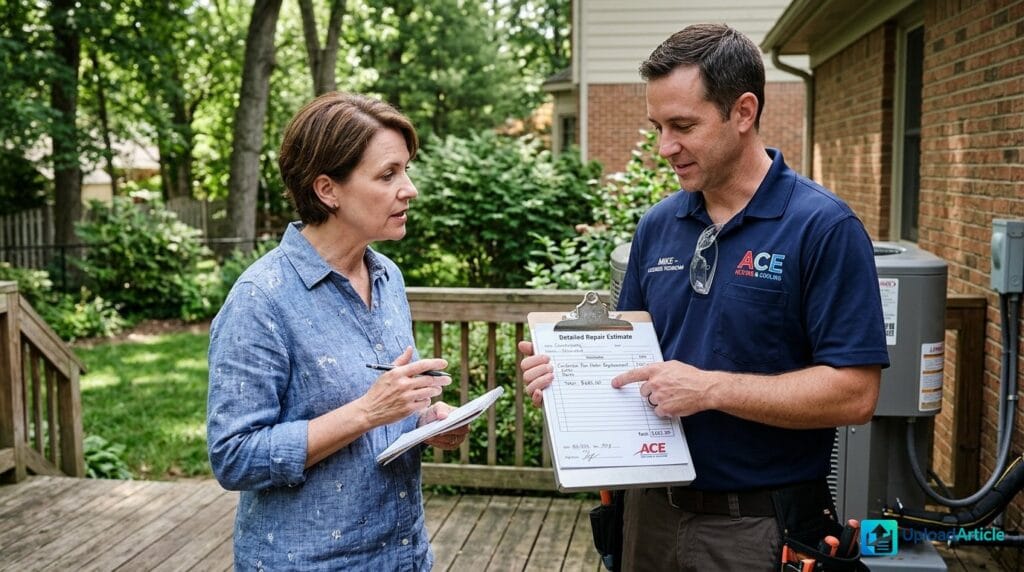
Warranties in the HVAC industry come in three layers, and understanding what each layer covers and who is responsible for honoring it prevents the moment when a failed compressor is discovered to be the homeowner’s financial problem.
The manufacturer’s equipment warranty, typically covering parts for ten years, protects against defects in the equipment itself. This warranty is only valid if the equipment is registered within a specified period after installation, usually sixty to ninety days. An air conditioning company should handle this registration and confirm it is complete before considering the job finished. An air conditioning company that does not handle the registration process or confirm that it has been completed is leaving the homeowner exposed. An air conditioning company that takes warranty registration seriously will provide confirmation that the paperwork has been filed and accepted.
The manufacturer’s warranty covers parts, not labor. A compressor that fails under warranty will be replaced at no cost for the part, but the eight to twelve hours of labor required to install it will be billed to the homeowner unless a separate labor warranty covers that expense. An air conditioning company that offers an extended labor warranty, typically three to ten years, is providing coverage that the manufacturer does not. An air conditioning company confident enough in its installation quality to cover labor for a decade is sending a signal worth paying attention to.
The contractor’s workmanship guarantee, separate from both manufacturer warranties, covers installation defects. If the system was installed incorrectly and that error causes a failure, the workmanship guarantee should cover the repair. An air conditioning company that cannot clearly explain its workmanship guarantee, including its duration and what voids it, is one whose guarantees should be treated as marketing language. An air conditioning company that cannot clearly explain what its workmanship guarantee covers, for how long, and under what conditions it can be voided, is a company whose guarantees should be treated as marketing language rather than enforceable commitments.
The Efficiency Ratings That Translate Directly Into Monthly Costs
SEER2 ratings, ENERGY STAR certifications, and efficiency percentages are numbers that most homeowners nod at without understanding what they mean for their monthly electricity bill.
A reputable air conditioning company translates those numbers into dollars. Based on the efficiency rating of the proposed system, the local electricity rate, and the expected annual cooling hours for the climate zone, the contractor should be able to estimate the annual operating cost of the system and compare it to the operating cost of the less expensive alternative that was also quoted.
This translation matters because the higher upfront cost of a more efficient system is only justified if the energy savings over the equipment’s lifetime exceed the premium paid at installation. A system that costs two thousand dollars more and saves two hundred dollars per year in electricity pays for itself in ten years. If the homeowner plans to sell the home in five years, that premium is not recovered through energy savings alone.
An air conditioning company that can have this conversation in specific numbers rather than general claims about efficiency is demonstrating the kind of consultative approach that separates a trusted contractor from a salesperson. An air conditioning company that cannot is selling equipment rather than outcomes. An air conditioning company that cannot, or will not, is selling equipment rather than outcomes.
The Maintenance Plan Without Which Your Warranty Means Nothing
Every manufacturer warranty in the HVAC industry contains language requiring that the equipment be maintained according to the manufacturer’s specifications. The homeowner who skips annual maintenance and then attempts to file a warranty claim when the system fails may discover that the manufacturer has grounds to deny the claim because the required maintenance was not documented.
A responsible air conditioning company offers a maintenance plan that satisfies the manufacturer’s requirements and provides documentation for warranty claims. An air conditioning company that installs the system and disappears may have technically completed the job, but it has set the homeowner up for a warranty denial years later. Annual maintenance typically includes coil cleaning, refrigerant level verification, electrical connection inspection, condensate drain clearing, airflow measurement, and thermostat calibration. An air conditioning company that performs all of these checks annually is protecting both your equipment and your warranty.
An air conditioning company that installs the system and disappears, offering no maintenance program and providing no guidance on what the manufacturer requires, has technically completed the installation while setting the homeowner up for a warranty denial. Do not let your air conditioning company be the reason your warranty claim is rejected. This is not a violation of the contract. It is an omission that the homeowner will not discover until it matters.
Frequently Asked Questions
How do I know if an air conditioning company is properly licensed and insured?
Verify the license number through your state licensing board’s online database, confirm the name on the license matches the air conditioning company on the contract, and ask to see a current certificate of general liability and workers compensation insurance.
What is a Manual J load calculation and why does it matter?
A Manual J load calculation is the industry-standard method for determining the correct cooling system size based on your home’s specific measurements including square footage, insulation, windows, and climate, and a professional air conditioning company performs this calculation before recommending equipment.
Should an air conditioning company pull permits for installation?
Yes, a reputable air conditioning company pulls the required municipal permits before starting work, which triggers an independent code inspection that verifies the installation meets safety and efficiency standards and protects you from liability during future home sales.
What should a written estimate from an air conditioning company include?
A complete estimate includes equipment model numbers, itemized components, labor costs, electrical work scope, equipment disposal, ductwork modifications, concrete pad or bracket, permit fees, and any exclusions, all broken out as line items rather than a single lump sum.
How do manufacturer warranties differ from contractor workmanship guarantees?
Manufacturer warranties cover equipment defects and typically last ten years for parts only, excluding labor, while contractor workmanship guarantees cover installation errors and vary significantly between air conditioning companies, making labor warranty coverage an essential question before hiring.
Is annual maintenance required to keep my air conditioning warranty valid?
Yes, most manufacturer warranties require documented annual maintenance performed according to manufacturer specifications, and an air conditioning company that offers a maintenance program helps you maintain warranty coverage while identifying problems before they become failures.
Conclusion
The eight questions in this guide exist because enough homeowners learned the answers the hard way. An air conditioning company that welcomes these questions, answers them specifically, and produces documentation that supports every claim is a company with nothing to hide. An air conditioning company that cannot do these things is telling you everything you need to know.
The Manual J load calculation that proves the system is correctly sized. The license number that verifies the contractor is legally authorized to perform the work. The line-item estimate that allows comparison between competing bids. The ductwork inspection that ensures the new system’s efficiency is not lost to leaks. The warranty explanation that distinguishes parts coverage from labor coverage from workmanship guarantees. The efficiency-to-dollars translation that justifies the investment. The maintenance program that protects warranty coverage while extending equipment life. The satisfaction guarantee that puts performance risk on the contractor rather than the homeowner.
An air conditioning company that can answer every one of these questions without hesitation, without defensiveness, and without changing the subject to monthly payment amounts is an air conditioning company worth hiring. An air conditioning company that cannot is telling you everything you need to know, and the message is not complicated.