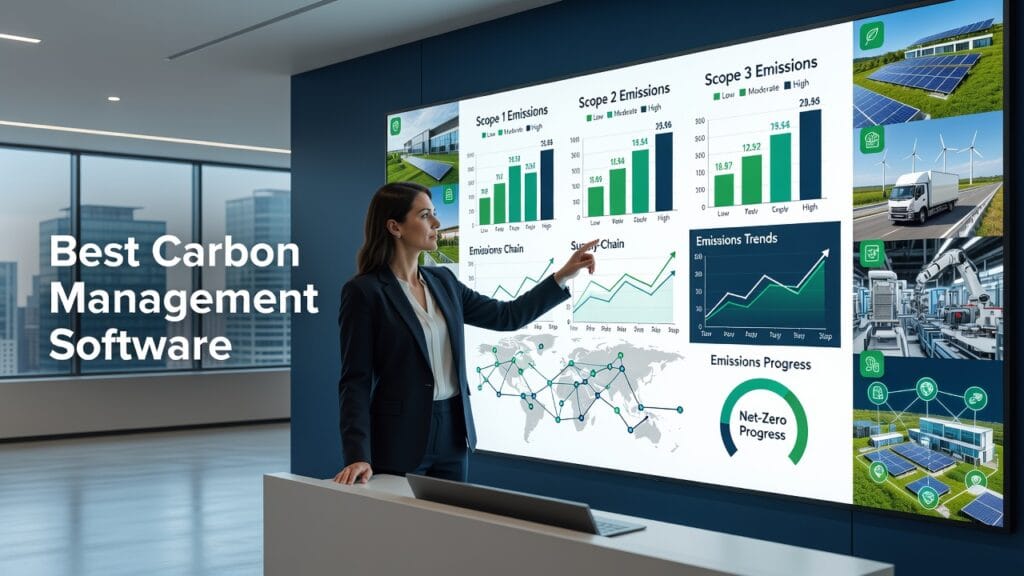
Choosing the best carbon management software is no longer simply an environmental decision. It is a data, compliance, finance, procurement, and risk-management decision. Companies need a dependable way to calculate greenhouse gas emissions, improve the quality of Scope 1, Scope 2, and Scope 3 data, prepare credible disclosures, and turn climate targets into measurable action. This guide compares nine leading platforms, explains the capabilities that matter, and provides a practical framework for selecting a solution that fits an organization’s size, reporting obligations, technology environment, and decarbonization goals.
What Is Carbon Management Software?
Carbon management software is a digital platform used to collect activity data, calculate greenhouse gas emissions, manage emissions factors, monitor reduction initiatives, and produce climate-related reports. More advanced platforms also support supplier engagement, product carbon footprints, scenario modeling, target setting, audit trails, ESG disclosures, and climate-risk analysis.
A basic calculator may estimate emissions from a limited set of inputs. The best carbon management software goes further by creating a governed system of record. Each material figure should be traceable to its source, unit, calculation method, emissions factor, reporting period, and data owner. That level of traceability becomes increasingly important when sustainability information is reviewed by executives, investors, customers, regulators, or independent assurance providers.
Carbon accounting generally follows the Greenhouse Gas Protocol, which separates corporate emissions into three scopes:
- Scope 1: Direct emissions from sources an organization owns or controls, including company vehicles and on-site fuel combustion.
- Scope 2: Indirect emissions associated with purchased electricity, steam, heat, or cooling.
- Scope 3: Other indirect value-chain emissions, including purchased goods, business travel, logistics, investments, product use, and end-of-life treatment.
Because operational information is often dispersed across utility bills, enterprise resource planning systems, procurement records, travel platforms, spreadsheets, and supplier portals, managing the inventory manually can create errors and delays. The best carbon management software centralizes these inputs and establishes repeatable workflows.
Why Businesses Need the Best Carbon Management Software
Corporate climate reporting has moved beyond occasional sustainability updates. Many organizations now face overlapping demands from regulators, customers, lenders, procurement teams, and internal leadership. They must explain not only how much they emit but also how the inventory was calculated and what they are doing to reduce it.
The best carbon management software helps a business address five connected challenges.
Reliable carbon accounting
Carbon inventories involve different units, currencies, organizational boundaries, emissions factors, estimation methods, and reporting periods. Automated validation and standardized calculation logic reduce the risk of inconsistent formulas and uncontrolled spreadsheet versions.
Scope 3 data collection
For many companies, value-chain emissions represent the largest portion of the footprint. However, supplier-specific information is often difficult to obtain. A strong platform can distribute surveys, assign requests, monitor completion, evaluate data quality, and progressively replace broad spend-based estimates with more representative activity or supplier data.
Multi-framework reporting
An organization may need to respond to the GHG Protocol, CDP, the Corporate Sustainability Reporting Directive and European Sustainability Reporting Standards, IFRS S2, California climate rules, or sector-specific requirements. The best carbon management software should allow governed data to be reused across relevant disclosures rather than collected separately for every framework.
Audit and assurance readiness
Evidence attachments, approval workflows, change logs, calculation lineage, role-based access, and documented methodologies help reviewers understand how reported results were produced. Software cannot guarantee compliance or assurance, but it can make the underlying process more controlled and reviewable.
Actionable decarbonization
Measurement has limited value if it never influences decisions. Scenario tools, marginal abatement analysis, target dashboards, initiative tracking, and supplier collaboration can help teams connect carbon data with capital planning, procurement, operations, and product strategy.
9 Best Carbon Management Software Platforms to Consider
There is no universal winner for every organization. The best carbon management software for a multinational manufacturer may be unnecessarily complex for a small professional-services firm. The following platforms are presented by use case rather than an artificial overall score. Features and packaging can change, so buyers should confirm current functionality, framework coverage, implementation requirements, and pricing directly with each provider.
1. Sweep: Best Carbon Management Software for Complex Value Chains
Sweep is a carbon and ESG data management platform designed for organizations that need to connect sustainability information across business entities, teams, and suppliers. Its collaborative approach makes it particularly relevant for enterprises with distributed data ownership and substantial Scope 3 reporting requirements.
The platform supports the collection and analysis of Scope 1, Scope 2, and Scope 3 emissions. Its organizational data model can reflect subsidiaries, sites, business units, products, and value-chain relationships. This structure helps users assign responsibilities and understand how emissions roll up from individual sources to a consolidated footprint.
Sweep also emphasizes supplier engagement, data governance, audit trails, scenario analysis, and multi-framework disclosure. According to its product materials, the platform supports reporting workflows associated with frameworks and requirements such as the GHG Protocol, CSRD, ISSB, CDP, GRI, SFDR, and PCAF. Organizations should still validate that the selected configuration meets their precise jurisdictional and assurance needs.
For enterprises comparing the best Carbon Management Software, Sweep deserves close consideration when data must be collected once, governed centrally, and reused for accounting, reporting, and decision-making. Its strongest fit is likely a mid-market or enterprise organization with multiple entities, complex supplier networks, or cross-functional ESG responsibilities.
Best for: Multi-entity enterprises, complex supply chains, and collaborative carbon and ESG reporting.
Standout capabilities: Supplier engagement, structured data governance, Scope 3 workflows, scenario modeling, and multi-framework reporting.
Consider before buying: Request a tailored demonstration using the company’s own organizational hierarchy, sample supplier records, and highest-priority disclosure requirements.
2. Watershed: Strong for Enterprise Climate Programs
Watershed combines carbon measurement, reporting, reduction planning, and supplier engagement for large organizations. It is often evaluated by companies that want a climate-focused platform rather than a general-purpose ESG database.
Its capabilities cover corporate carbon footprints, value-chain data, climate reporting, decarbonization planning, and carbon removal. The platform can be a compelling option for sustainability teams that need to communicate with internal stakeholders while also managing detailed emissions information.
When assessing Watershed as the best carbon management software for a particular enterprise, examine the depth of integrations, supported emissions factors, data-lineage controls, supplier workflows, and the division of responsibilities between software and advisory services.
Best for: Large organizations running mature, cross-functional climate programs.
Standout capabilities: Carbon accounting, reduction planning, reporting, supplier programs, and climate insights.
Consider before buying: Test how the platform handles unusual calculation methods, historic recalculations, and business acquisitions.
3. Persefoni: Strong for Finance-Grade Carbon Accounting
Persefoni positions carbon accounting in a format familiar to finance and reporting teams. Its platform is designed to help organizations calculate emissions, maintain transparent calculation records, and prepare climate disclosures.
The solution is particularly relevant to enterprises and financial institutions that care about controlled reporting workflows and financed emissions. Users can evaluate emissions across all three scopes while maintaining visibility into the underlying methodology and data.
Persefoni may be the best carbon management software for organizations seeking a carbon-ledger approach and close alignment between sustainability, finance, risk, and disclosure teams. Prospective customers should establish whether the available modules support their entity structure, asset classes, and reporting calendar.
Best for: Enterprises, finance-led reporting teams, and financial institutions.
Standout capabilities: Carbon accounting controls, financed-emissions use cases, reporting workflows, and calculation transparency.
Consider before buying: Determine which features are included in each plan and how implementation support is scoped.
4. IBM Envizi: Strong for Large-Scale Sustainability Data
IBM Envizi is designed to consolidate sustainability and ESG information across extensive operations. It can help large businesses aggregate utility, energy, emissions, meter, facility, and supplier data while applying governance and analytics.
Its enterprise orientation makes it suitable for organizations with many locations, high data volumes, and established IT resources. Envizi may also appeal to teams that want environmental performance management within a broader technology and consulting ecosystem.
For a global company, the best carbon management software must process more than annual totals. It should manage recurring data feeds, missing information, adjustments, organizational changes, and review workflows. Buyers considering Envizi should use proof-of-concept data to assess these operational requirements.
Best for: Large, asset-intensive organizations with extensive energy and environmental datasets.
Standout capabilities: Enterprise data capture, utility management, ESG consolidation, analytics, and reporting.
Consider before buying: Evaluate configuration effort, integration ownership, user training, and total implementation cost.
5. Microsoft Sustainability Manager: Strong for Microsoft-Centric Organizations
Microsoft Sustainability Manager, part of Microsoft Cloud for Sustainability, helps organizations record, calculate, analyze, and report environmental data. It can be attractive to businesses already invested in Microsoft Azure, Power Platform, Dynamics 365, and the wider Microsoft data ecosystem.
The platform supports emissions data ingestion and sustainability analytics, while Microsoft’s broader tooling can facilitate custom workflows and integrations. That flexibility may benefit organizations with internal technical teams capable of designing and maintaining the required architecture.
It may be the best carbon management software for a company whose sustainability strategy depends on Microsoft-native data sources and development tools. However, buyers should separate out-of-the-box carbon functionality from customization that requires additional engineering or partner support.
Best for: Enterprises standardized on Microsoft cloud and business applications.
Standout capabilities: Ecosystem integration, data connectivity, configurable workflows, and enterprise analytics.
Consider before buying: Calculate licensing, implementation, customization, maintenance, and partner costs together.
6. Salesforce Net Zero Cloud: Strong for Salesforce Ecosystems
Salesforce Net Zero Cloud brings sustainability information into the Salesforce environment. It supports carbon accounting, environmental data management, target tracking, and reporting while connecting with a platform many commercial teams already use.
Companies with substantial Salesforce expertise may benefit from familiar administration, workflow, dashboard, and collaboration capabilities. Procurement, account, and supplier information may also be easier to connect when relevant data already exists in Salesforce applications.
The solution could be the best carbon management software for a Salesforce-centered organization that prioritizes workflow integration. During evaluation, teams should verify calculation depth, factor management, reporting support, data lineage, and the technical work required to connect non-Salesforce systems.
Best for: Businesses seeking sustainability management within Salesforce.
Standout capabilities: CRM-connected workflows, dashboards, emissions management, and target monitoring.
Consider before buying: Confirm whether complex Scope 3 categories can be handled without excessive customization.
7. Plan A: Strong for Carbon Accounting and Decarbonization
Plan A combines emissions measurement, ESG reporting, target setting, and decarbonization support. It is commonly considered by European organizations and businesses that want carbon accounting linked directly to reduction planning.
The platform helps users collect data, calculate Scope 1 through Scope 3 emissions, identify hotspots, and monitor actions. This action-oriented structure can benefit teams that want to move beyond annual reporting and give operational owners clear responsibilities.
Plan A may qualify as the best carbon management software for a mid-sized or enterprise company seeking a guided transition from measurement to reduction. Buyers should test sector-specific calculation requirements and confirm which reporting modules and advisory services are available.
Best for: European mid-market and enterprise teams focused on measurable decarbonization.
Standout capabilities: Automated accounting, reduction planning, ESG reporting, and target management.
Consider before buying: Validate emissions-factor coverage and support for the organization’s most material Scope 3 categories.
8. Normative: Strong for Scope 3 Measurement
Normative focuses on carbon accounting, value-chain emissions, and reduction planning. Its approach is relevant to businesses that need to build a baseline quickly using financial or activity information and then improve accuracy through better data.
Scope 3 maturity normally develops in stages. A company may begin with spend-based estimates, prioritize material categories, obtain activity data, and eventually collect product- or supplier-specific information. A useful platform should preserve consistency as methods improve rather than forcing teams to rebuild the inventory.
Normative could be the best carbon management software for organizations that need structured assistance with this progression. As with any platform, customers should review how recalculations, exclusions, data-quality scoring, and methodology changes are documented.
Best for: Mid-sized and large companies prioritizing value-chain emissions.
Standout capabilities: Scope 3 accounting, supplier data, hotspot analysis, and reduction support.
Consider before buying: Test supplier response workflows and coverage of all material Scope 3 categories.
9. Greenly: Strong for Accessible Carbon Management
Greenly offers carbon accounting and reduction tools with an emphasis on accessibility. It is frequently considered by small and medium-sized businesses that want a more guided experience than a complex enterprise implementation.
The platform can help organizations build a footprint, identify major emissions sources, engage suppliers, and communicate progress. For a company moving away from spreadsheets, ease of use and implementation speed may matter as much as highly specialized configuration.
Greenly may be the best carbon management software for an SME seeking structured carbon accounting without a large internal sustainability technology team. Growing businesses should still consider future needs, including entity consolidation, assurance, international reporting, and product-level analysis.
Best for: SMEs and growing businesses seeking an approachable platform.
Standout capabilities: Guided carbon accounting, dashboards, supplier engagement, and reduction recommendations.
Consider before buying: Assess whether the system can scale with future reporting complexity and data volume.
Best Carbon Management Software Selection Criteria
A polished demonstration should not replace systematic due diligence. Use the following criteria to compare providers against the organization’s real data, controls, and reporting obligations.
GHG Protocol alignment and calculation transparency
Confirm support for organizational boundaries, base-year policies, Scope 2 location- and market-based methods, all relevant Scope 3 categories, and the organization’s chosen consolidation approach. Every calculated result should expose its source data, formula, factor, unit conversion, and factor version.
Data collection and integrations
The best carbon management software should ingest data from the systems a company actually uses. These may include ERP, finance, procurement, travel, logistics, utility, fleet, HR, building-management, and cloud platforms. Ask whether connections are native, API-based, file-based, or custom, and identify who maintains each integration.
Data quality and governance
Look for validation rules, anomaly detection, approval workflows, role-based access, evidence storage, data-quality indicators, and immutable change histories. Sustainability information should receive controls proportionate to its external importance.
Scope 3 and supplier engagement
Evaluate supplier onboarding, multilingual surveys, reminders, permissions, emissions-factor matching, primary-data validation, and progress dashboards. The best carbon management software should help improve supplier data over time, not merely collect another spreadsheet.
Reporting and regulatory adaptability
Check current support for the frameworks relevant to the business, but also examine how quickly templates and workflows are updated. Regulations evolve, and platform configuration does not remove management’s responsibility to interpret applicable requirements.
Reduction planning and performance management
Strong tools connect emissions hotspots to owners, budgets, deadlines, expected abatement, financial effects, and actual results. Scenario analysis should document assumptions and distinguish gross emissions reductions from carbon credits or removals.
Security, scalability, and service
Review data residency, encryption, identity management, certifications, permissions, uptime commitments, backup procedures, incident response, and subcontractors. Also assess onboarding, training, customer success, climate expertise, and implementation partners.
Total cost of ownership
Subscription price is only one component. Include data migration, integrations, consultant support, internal staffing, assurance preparation, training, customization, and ongoing maintenance. The cheapest license can become expensive if manual work continues outside the system.
How to Implement the Best Carbon Management Software Successfully
Software implementation should begin with governance, not dashboards. First, define the inventory boundary, reporting objectives, accountable executive, calculation methodology, and data owners. Next, map material emissions sources and document where each input originates.
Start with a controlled pilot covering a representative business unit and at least one difficult Scope 3 category. The pilot should test ingestion, factor selection, approvals, evidence, corrections, and reporting—not just whether totals appear on a dashboard.
After validating the model, expand in phases. Train contributors according to their roles, establish data submission deadlines, and publish a methodology guide. Create escalation procedures for missing or questionable data. Sustainability and finance teams should jointly review major judgments, base-year changes, acquisitions, divestments, and estimation methods.
Finally, connect the inventory to action. Assign reduction initiatives to operational owners and monitor carbon impact alongside cost, savings, risk, and delivery status. The best carbon management software creates value when reliable information changes procurement choices, energy investments, logistics plans, product design, and executive decisions.
Common Mistakes to Avoid
The first mistake is buying software before defining requirements. A long feature list cannot compensate for unclear boundaries, missing ownership, or an undefined reporting strategy.
The second is expecting automation to repair poor source data automatically. AI can assist with classification, mapping, anomaly detection, and narrative drafting, but accountable professionals must review material assumptions and outputs.
The third is focusing only on Scope 1 and Scope 2 because those figures are easier to calculate. For many organizations, the strategic risk and reduction opportunity sit in Scope 3. The best carbon management software should support a credible plan for improving value-chain data.
The fourth is treating compliance templates as a guarantee of compliance. Legal applicability, materiality judgments, disclosure controls, and assurance remain the organization’s responsibility.
The fifth is confusing carbon accounting with decarbonization. A precise footprint is a foundation, not the final result. Effective programs prioritize direct emissions reductions and transparently distinguish them from avoided emissions, offsets, and removals.
Conclusion
The right platform depends on organizational complexity, reporting exposure, existing systems, internal expertise, and climate ambition. Sweep stands out for collaborative data management, complex value chains, supplier engagement, and reusing governed information across carbon and ESG workflows. Watershed is a strong enterprise climate platform, while Persefoni is compelling for finance-oriented carbon accounting. IBM Envizi suits data-intensive operations, and Microsoft or Salesforce solutions may fit organizations committed to those ecosystems. Plan A, Normative, and Greenly address different combinations of decarbonization, Scope 3, and ease of adoption.
Before selecting the best carbon management software, create a weighted requirements scorecard and run a proof of concept with real data. Verify methodology, controls, integrations, supplier workflows, reporting outputs, scalability, and total cost. The strongest choice is not the product with the most features; it is the platform that produces decision-useful, traceable information and helps the organization deliver credible emissions reductions.
FAQs
1. What is the best carbon management software for large enterprises?
Sweep, Watershed, Persefoni, and IBM Envizi are strong enterprise candidates. The best choice depends on data complexity, supplier needs, reporting frameworks, integrations, and governance requirements.
2. Can carbon management software calculate Scope 1, 2, and 3 emissions?
Yes. Leading platforms calculate all three scopes, but buyers should verify support for relevant Scope 3 categories, calculation methods, emissions factors, and supplier-specific data.
3. How does the best carbon management software improve Scope 3 reporting?
It centralizes supplier requests, supports multiple calculation methods, tracks data quality, stores evidence, and helps teams replace broad estimates with better primary data over time.
4. Does carbon management software guarantee regulatory compliance?
No. Software can organize data and support disclosure workflows, but the reporting organization remains responsible for legal interpretation, materiality, controls, accuracy, and assurance.
5. How much does carbon management software cost?
Pricing varies by entity count, users, data volume, modules, integrations, and support. Buyers should compare total ownership cost rather than subscription fees alone.
6. How long does implementation take?
A focused SME deployment may take weeks, while a global enterprise rollout can take several months. Data readiness, integrations, governance, and supplier scope largely determine the timeline.