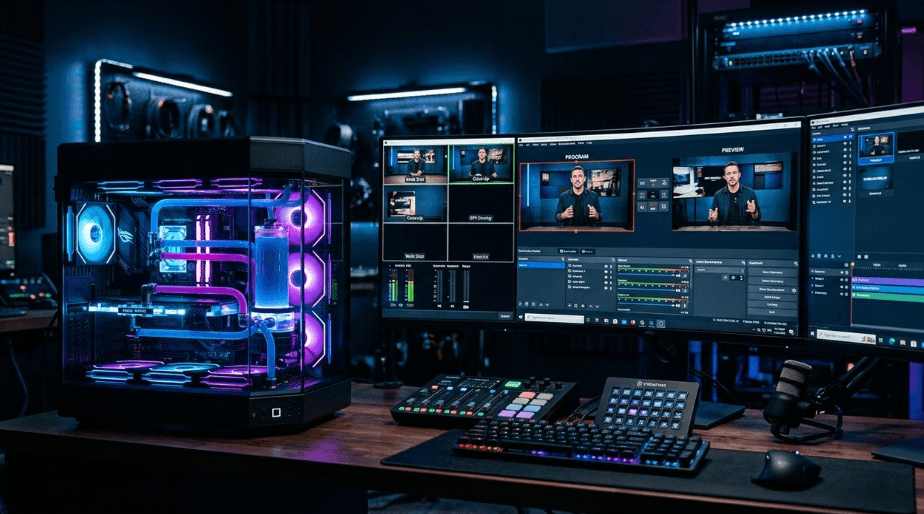
vMix Topaz Edition workstations are purpose-built computers for professional live production. The vMix Topaz Edition is one of the most demanding tiers of vMix software, supporting 4K output, instant replay, and multi-camera switching. A dedicated workstation ensures these features run without dropped frames or buffering during a live broadcast.
This guide explains what vMix Topaz Edition workstations need, how Cloud Ninjas configures them, and how to choose the right hardware for reliable 4K streaming.
What Are vMix Topaz Edition Workstations?
vMix Topaz Edition workstations are high-performance PCs configured specifically for the vMix Topaz Edition of live production software. This tier handles 4K resolution, multiple camera inputs, advanced overlays, and instant replay. Ordinary office computers cannot sustain this workload, which is why dedicated hardware matters. A purpose-built machine is the foundation of reliable live production.
Cloud Ninjas builds vMix Topaz Edition workstations around Intel Core Ultra processors, DDR5 memory, and NVIDIA RTX GPUs. The recommended configuration uses an Intel Core Ultra 9 285K CPU, 128GB of DDR5 memory, an NVIDIA GeForce RTX 5080 with 16GB of VRAM, and 6TB of NVMe SSD storage running Windows 11 Pro.
How vMix Uses Your Hardware
vMix relies heavily on the GPU for encoding and effects. A fast NVIDIA card handles real-time video processing, while the CPU manages inputs and switching. Memory supports multiple simultaneous feeds, and fast storage keeps recording and replay smooth. Understanding this split helps you appreciate why vMix Topaz Edition workstations balance all four components so carefully.
Why a Dedicated System Matters
Live production cannot pause to buffer. A single dropped frame during a broadcast is visible to every viewer. vMix Topaz Edition workstations are engineered to keep every component running smoothly together, which consumer PCs often fail to do under sustained load. This is the core reason serious producers invest in dedicated vMix Topaz Edition workstations rather than repurposed desktops.
The Recommended vMix Topaz Edition Configuration
The Topaz Edition workload demands balanced hardware, and Cloud Ninjas recommends specific components for optimal results. These recommendations form the baseline for all vMix Topaz Edition workstations it ships.
Processor and Memory
Intel Core Ultra 9 285K
This 24-core processor handles multiple HD and 4K camera feeds, complex overlays, and layered graphics at once. Paired with 128GB of DDR5 memory, it reduces buffering and supports uninterrupted playback during high-resolution events.
Graphics in vMix Topaz Edition Workstations
NVIDIA GeForce RTX 5080
The RTX 5080 with 16GB of VRAM delivers the GPU acceleration vMix needs for encoding, effects, and smooth multi-layer switching. NVIDIA hardware encoding is a core requirement for efficient 4K output.
Storage for vMix Topaz Edition Workstations
6TB NVMe SSD
vMix workflows demand rapid access to large video files and recorded feeds. High-throughput NVMe storage accelerates media loading, cueing, and recording, which minimizes latency during multi-camera productions.
Cooling and Reliability
Liquid Cooling in vMix Topaz Edition Workstations
Sustained encoding generates heat, and heat causes throttling. The Neon Fox liquid-cooled chassis with Noctua fans and an AIO cooler keeps temperatures low, so vMix Topaz Edition workstations stay consistent through long broadcasts.
Configuring Your vMix Topaz Edition Workstation
Cloud Ninjas offers flexible configurations so you can match the hardware to your exact workload and budget. Every vMix Topaz Edition workstation is built to order, which means you pay only for the performance you need. This section walks through the key choices when configuring vMix Topaz Edition workstations.
Processor Choices
Builders can choose from Intel Core Ultra 5, 7, and 9 processors. The Core Ultra 9 285K is the top recommendation, while Core Ultra 7 and 5 options offer lower-cost entry points for smaller productions. This range lets customers order vMix Topaz Edition workstations at several performance levels.
GPU Options
The RTX 5080 is the flagship choice, but the configurator supports selecting GPUs to fit your power and budget requirements. More demanding 4K and multi-replay workflows benefit from the highest available graphics power, and vMix Topaz Edition workstations can be configured with up to two GPUs where the power supply allows.
Memory and Storage Scaling
Memory can scale up to four DDR5 modules, and NVMe storage options let you add capacity for longer recordings and larger replay caches. This flexibility is central to how vMix Topaz Edition workstations are built, since different productions demand different amounts of headroom.
Why Hardware Quality Determines Broadcast Reliability
The difference between a smooth broadcast and a failed one often comes down to the machine underneath the software. This is where vMix Topaz Edition workstations separate themselves from generic computers.
Balanced Component Communication
vMix Topaz Edition workstations ensure efficient communication between CPU, GPU, memory, and storage. This balanced architecture enables low-latency switching and stable multi-layer effects across multiple camera inputs. It is a design goal that only purpose-built vMix Topaz Edition workstations achieve consistently.
Sustained Performance Under Load
Live events run for hours, not minutes. Liquid cooling and high-quality power delivery keep the system stable during long productions. This endurance is essential for professional broadcast environments that depend on vMix Topaz Edition workstations.
Reduced Downtime Risk
Every component in a vMix Topaz Edition workstation is selected for reliability. This reduces the chance of a mid-event failure, protecting both your reputation and your revenue.
Real-Time Market Context for Live Production
The demand for professional live production hardware is growing alongside the streaming industry. Industry research from Mordor Intelligence projects the live streaming market to grow from $97.39 billion in 2026 to $318.56 billion by 2031, a compound annual growth rate of 26.74%. Live streaming pay-per-view alone is expected to reach $2.21 billion in 2026.
This rapid growth means more studios, churches, esports teams, and broadcasters are investing in reliable production hardware. A purpose-built system has become the standard rather than the exception. This is exactly why dedicated vMix Topaz Edition workstations are in steady demand across the industry.
Who Uses These Systems
Broadcast Studios
Studios producing multi-camera shows rely on vMix Topaz Edition workstations for 4K switching, replay, and graphics without interruption.
Houses of Worship
Churches streaming services to remote congregations need dependable vMix Topaz Edition workstations that run weekly without failure.
Esports and Gaming
Esports broadcasters require instant replay and multiple inputs at low latency. These workloads demand vMix Topaz Edition workstations with a dedicated GPU and fast storage.
Corporate and Education
Companies and universities producing live events, lectures, and town halls use vMix Topaz Edition workstations for professional-grade streaming.
How to Choose the Right vMix Topaz Edition Workstation
Selecting the right system involves matching hardware to your production scale.
Match the CPU to Your Input Count
More camera feeds and overlays demand more processing power. A Core Ultra 9 handles the heaviest workloads, while Core Ultra 7 suits mid-size productions. Choosing the right processor is the first step in configuring vMix Topaz Edition workstations correctly.
Prioritize GPU Performance
The GPU is the heart of vMix encoding. Choose the most capable NVIDIA card your budget allows, especially for 4K and multi-output workflows.
Invest in Fast Storage
NVMe storage prevents recording and replay bottlenecks. Larger capacities support longer events and higher bitrate captures, which is why 6TB NVMe is standard on the recommended vMix Topaz Edition workstations.
Consider Future Growth
Choose a configurable system you can upgrade. vMix Topaz Edition workstations that support memory and storage expansion protect your investment as your production grows.
Frequently Asked Questions
What hardware does vMix Topaz Edition need?
The recommended setup includes an Intel Core Ultra 9 285K, 128GB DDR5, an NVIDIA RTX 5080, and 6TB NVMe storage running Windows 11 Pro.
Why do I need a dedicated workstation for vMix?
Live production demands sustained performance with no dropped frames. Balanced, purpose-built vMix Topaz Edition workstations deliver the reliability that consumer PCs cannot match.
How much RAM do vMix Topaz Edition workstations need?
Cloud Ninjas recommends 128GB of DDR5 in its vMix Topaz Edition workstations to handle multiple HD or 4K feeds, complex overlays, and layered graphics simultaneously.
Which GPU is best for vMix Topaz Edition?
An NVIDIA GeForce RTX 5080 with 16GB of VRAM is the recommended GPU for vMix Topaz Edition workstations, delivering efficient 4K encoding and smooth multi-layer switching.
Can I customize my vMix Topaz Edition workstation?
Yes, you can configure the processor, GPU, memory, and storage to match your workload and budget through Cloud Ninjas’ configurator for vMix Topaz Edition workstations.
What operating system do these workstations use?
They ship with Windows 11 Pro, the recommended platform for running vMix live production software.
Conclusion
vMix Topaz Edition workstations give broadcasters, studios, and event producers the reliable hardware they need for professional 4K live production. By pairing a high-core-count Intel Core Ultra processor with an NVIDIA RTX GPU, fast NVMe storage, and liquid cooling, these systems deliver the sustained performance that live switching and instant replay demand. As the live streaming market grows toward $318 billion by 2031, investing in purpose-built hardware is no longer optional for serious productions. Choose a configurable, upgradeable system that matches your input count and budget, and your broadcasts will run smoothly when it matters most.