Hair loss affects more than eighty million adults across the United States, yet the surgical solutions that work brilliantly for men often require fundamentally different approaches when applied to women.
The biological mechanisms driving male and female pattern hair loss differ significantly, and the surgical approaches designed to address each gender’s unique needs must reflect those underlying differences with precision.
A man experiencing a receding hairline and a woman noticing widening part lines may both seek surgical restoration, but the techniques, artistry, recovery protocols, and candidacy evaluations for their respective procedures diverge in ways that directly determine whether the outcome looks natural or artificial.
According to data compiled by leading hair restoration organizations, the success rate of properly planned hair transplant procedures exceeds ninety percent for qualified candidates, yet this statistic applies only when the surgical approach is correctly matched to the patient’s gender-specific hair loss pattern.
In Raleigh, North Carolina, a growing number of specialized clinics offer both male and female hair transplant procedures, making the Research Triangle region a notable destination for patients seeking gender-informed surgical restoration at pricing that averages fifteen to twenty-five percent below northeastern metropolitan areas.
This comprehensive guide examines the eight critical differences between male and female restoration approaches, explores the techniques available locally, and provides the detailed information needed to make a confident, informed decision about your restoration journey.
Understanding the Biological Differences Behind Male and Female Hair Transplant Procedures
Before examining surgical techniques, patients must recognize that the underlying biology of hair loss differs fundamentally between genders, and effective surgical restoration must account for these biological distinctions from the very first consultation.
How Male Pattern Baldness Creates Predictable Donor Zones
Male androgenetic alopecia follows a well-documented progression classified by the Norwood scale, beginning with temple recession, advancing to crown thinning, and eventually leaving a horseshoe-shaped band of hair around the sides and back of the scalp.
This predictable pattern creates what surgeons call a stable donor zone, an area of hair follicles genetically resistant to the hormone dihydrotestosterone that drives pattern baldness.
Because male hair restoration can reliably harvest from this resistant zone, surgeons can plan transplant sessions with confidence that the donor follicles will continue growing permanently in their new locations.
Why Female Hair Loss Presents Unique Diagnostic Challenges
Female pattern hair loss rarely follows the localized balding patterns seen in men.
Instead, women typically experience diffuse thinning across the entire top of the scalp, with widening part lines and gradually decreasing density rather than distinct bald patches.
The Ludwig Classification system, which surgeons use to stage female hair loss, reflects this diffuse nature and complicates the donor assessment that precedes female hair transplant procedures significantly.
Because thinning often extends into the donor area itself in female patients, a comprehensive medical evaluation including blood panels, hormonal assessments, and scalp analysis becomes essential before determining candidacy for surgical restoration.
8 Critical Differences Between Male and Female Hair Transplant Procedures
The following eight differences represent the most significant factors separating male and female surgical hair restoration, and understanding each distinction helps patients select the right surgeon and approach for their specific needs.
1. Candidacy Evaluation Protocols Differ Significantly Between Genders
Male candidates for hair transplant procedures typically require confirmation of stable androgenetic alopecia with an accessible donor zone, making the evaluation process relatively straightforward.
Female candidates, however, must undergo a far more extensive screening protocol because numerous medical conditions including thyroid disorders, iron deficiency anemia, polycystic ovary syndrome, hormonal fluctuations, and autoimmune diseases can cause or contribute to hair thinning.
A qualified Raleigh specialist performing hair transplant procedures on women will order comprehensive laboratory testing and may recommend treating underlying conditions for several months before proceeding with surgery.
This mandatory medical groundwork for female hair transplant procedures means the path from initial consultation to surgery day typically extends several months longer for women than for men, but skipping this step dramatically increases the risk of transplant failure.
2. Donor Area Preparation Involves Drastically Different Approaches
For the vast majority of male hair transplant procedures, shaving the entire donor area on the back and sides of the scalp is standard practice.
This complete shave allows the surgical team to extract grafts with maximum speed and precision, and most men adapt easily to the temporary buzz-cut appearance.
Female hair transplant procedures, by contrast, almost never involve full head shaving because the social and professional consequences of a shaved head are typically unacceptable for women.
Instead, surgeons utilize specialized no-shave or stealth shaving techniques that trim only small, discrete bands of hair in the donor region, carefully concealed beneath the surrounding longer hair.
While this approach makes extraction more technically demanding and time-consuming for the surgical team, it enables women to return to normal professional and social activities without visible signs of having undergone hair transplant procedures.
3. Surgical Goals Center on Different Objectives for Each Gender
Male hair transplant procedures typically focus on hairline reconstruction, restoring a defined frame to the face by rebuilding the frontal hairline, filling temple recession, and adding density to the crown region.
The surgical objective involves creating a mature, age-appropriate masculine hairline with slight irregularity and subtle recession that looks natural rather than artificially youthful.
Female hair transplant procedures, meanwhile, almost never involve hairline lowering or dramatic reshaping.
Instead, the goal centers on density enhancement, strategically adding grafts between existing thinning hairs to restore overall fullness without altering the natural hairline position that most women retain even through significant thinning.
This fundamental difference in surgical objectives between male and female hair transplant procedures dictates every subsequent decision about graft count, placement density, and surgical technique selection.
4. Hairline Design Requires Radically Different Artistic Approaches
The artistry of hairline creation differs so fundamentally between genders that a surgeon highly skilled in male hair transplant procedures may produce unnatural results when applying the same design principles to a female patient.
Male hairlines should appear slightly irregular, with micro-irregularities and macro-irregularities that mimic the natural randomness of biological hair growth, and surgeons use single-hair follicular units at the very front to create a soft, feathered transition zone.
Female hairlines are typically lower, rounder, softer, and lack the deep temporal recession angles that characterize masculine hairlines, demanding an entirely different graft placement strategy during female hair transplant procedures.
Additionally, the natural hair flow pattern in women often involves complex cowlicks, swirls, and multi-directional growth that must be replicated with extraordinary precision during hair transplant procedures to avoid an artificial appearance.
5. FUE Versus FUT Technique Selection Varies by Gender Considerations
Follicular Unit Extraction, or FUE, harvests individual follicular units using a micropunch tool, leaving tiny dot scars that remain virtually invisible even with short hairstyles.
Follicular Unit Transplantation, or FUT, removes a strip of scalp from the donor area and dissects it into individual grafts under microscopic magnification, producing a linear scar hidden beneath surrounding hair.
For male hair transplant procedures, FUE has become the dominant technique because it allows men to wear their hair short on the back and sides without revealing scar tissue.
For female hair transplant procedures, FUE is typically preferred because it avoids the extensive shaving that FUT requires and eliminates the linear scar concern, though the no-shave FUE variant used for women demands greater surgical time and technical skill.
Some women with longer hair who never plan to wear short styles may still benefit from FUT for female hair transplant procedures, particularly when maximum graft yield from a single session is the priority.
6. Graft Count Requirements and Session Planning Follow Different Logic
Male hair transplant procedures often involve larger graft counts in a single session, frequently ranging from two thousand to four thousand grafts, because the concentrated balding zones allow for dense packing in clearly defined recipient areas.
Female hair transplant procedures typically involve more conservative graft counts per session, often between one thousand and twenty-five hundred grafts, because the diffuse thinning pattern requires careful placement between existing follicles without damaging the surrounding healthy hairs.
The lower per-session graft count for female hair transplant procedures reflects not lesser need but greater surgical complexity, as each graft must be precisely positioned within a field of existing hair rather than planted in a clearly demarcated bald zone.
7. Recovery Experiences and Concealment Options Differ Markedly
Male patients undergoing hair transplant procedures with full shaving typically face a recovery period where the shaved appearance and visible scabbing are apparent for seven to ten days, after which the transplanted hairs shed and regrowth begins over the subsequent months.
Most men can return to office environments and social settings within a week, particularly if they are comfortable with closely cropped hairstyles.
Female patients benefit enormously from the no-shave techniques used in their hair transplant procedures because the surrounding long hair completely conceals both the donor extraction sites and the recipient implantation zones.
This concealment advantage means women can often return to work within days without colleagues or acquaintances detecting that hair transplant procedures were performed, an option that simply does not exist for men unless they undergo the more expensive and time-intensive no-shave approach.
8. Long-Term Planning and Maintenance Protocols Address Different Risk Profiles
Because male pattern baldness is progressive, surgeons planning hair transplant procedures for men must strategically conserve donor hair for potential future sessions as native, non-transplanted hair continues thinning over subsequent decades.
This long-term donor management strategy directly influences graft placement density, hairline positioning, and the decision to use medical maintenance therapies like finasteride and minoxidil indefinitely after surgery.
For female hair transplant procedures, the long-term planning focuses more heavily on ongoing medical management because female hair loss often has multifactorial causes that continue affecting non-transplanted hair.
Women who undergo hair transplant procedures typically benefit from continued treatment of underlying medical conditions, regular laboratory monitoring, and adjunct therapies including platelet-rich plasma treatments and low-level laser therapy to maintain density in untreated scalp regions.
Comparing Hair Transplant Techniques Available in Raleigh NC
Patients researching hair transplant procedures in the Raleigh area will encounter two primary surgical techniques, each with distinct advantages depending on gender and individual circumstances.
FUE Hair Transplant Procedures for Both Men and Women
Follicular Unit Extraction removes individual follicular units one by one using a micro-punch instrument ranging from 0.7 to 1.0 millimeters in diameter.
The individual extraction approach of FUE hair transplant procedures eliminates the linear scar associated with strip harvesting and typically results in faster healing with less post-operative discomfort.
In Raleigh, FUE pricing for hair transplant procedures ranges from approximately four thousand to eleven thousand dollars depending on graft count, with per-graft costs averaging between two dollars and seventy-five cents and five dollars.
For women, the no-shave FUE variant used in female hair transplant procedures adds technical complexity and surgical time, which may increase the total cost compared to a standard male FUE session of equivalent graft count.
FUT Hair Transplant Procedures and When They Remain Appropriate
Follicular Unit Transplantation, sometimes called the strip method, removes a narrow strip of hair-bearing scalp from the donor region, closes the site with sutures, and dissects the strip into individual follicular units under microscopic guidance.
FUT hair transplant procedures can yield higher total graft counts in a single session compared to FUE, making this technique valuable for male patients with extensive baldness requiring maximum coverage in one surgery.
In Raleigh, FUT pricing for hair transplant procedures ranges from approximately thirty-five hundred to seventy-five hundred dollars, with per-graft costs between one dollar and seventy-five cents and three dollars and twenty-five cents.
While FUT remains less common for female hair transplant procedures due to the linear scar and shaving requirements, women who wear their hair long and prioritize maximum graft yield may still benefit from this approach after thorough consultation.
Cost Considerations for Hair Transplant Procedures in Raleigh North Carolina
The Raleigh market for hair transplant procedures offers competitive pricing compared to national averages, making the Research Triangle an attractive destination for patients seeking quality restoration at reasonable costs.
Male hair transplant procedures in Raleigh typically range from four thousand to fifteen thousand dollars depending on technique, graft count, surgeon experience, and clinic reputation.
Female hair transplant procedures in Raleigh often fall within a similar price range, though the additional complexity of no-shave techniques and the more extensive pre-surgical medical evaluation may increase total costs slightly compared to a male session of equivalent graft numbers.
Most reputable Raleigh clinics include the initial consultation, the surgical procedure itself, prescribed post-operative medications, and at least one follow-up visit in their quoted pricing for hair transplant procedures.
Patients should verify exactly what the quoted price includes before committing, as some clinics quote surgical fees only while omitting facility charges, anesthesia costs, or required post-operative care from their advertised prices for hair transplant procedures.
The Consultation Process for Hair Transplant Procedures in Raleigh

A thorough consultation determines whether a patient qualifies as a good candidate for surgical restoration, and the depth of this evaluation directly correlates with the likelihood of successful hair transplant procedures.
What Men Should Expect During Their Initial Consultation
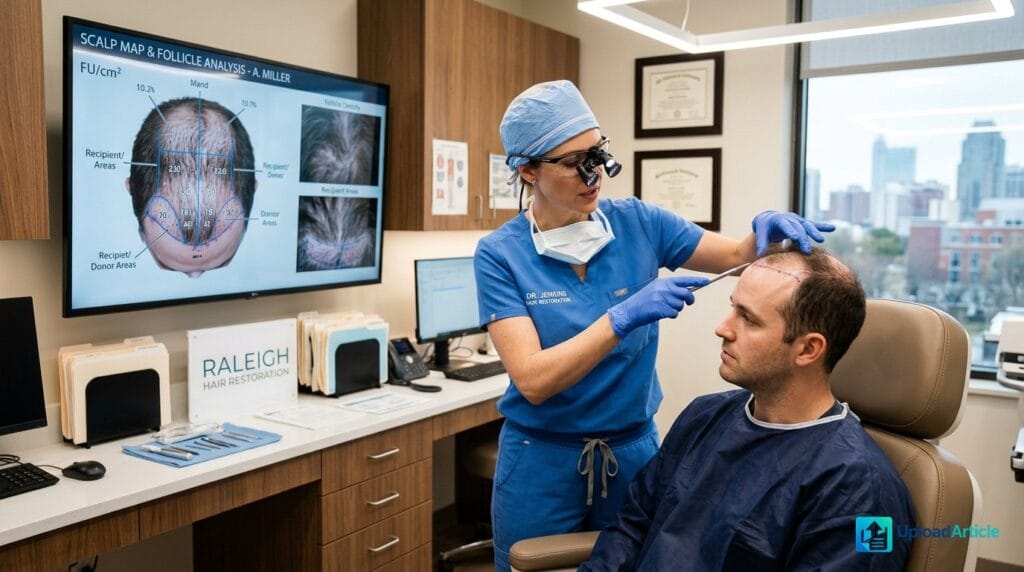
A male hair transplant consultation in Raleigh typically includes a Norwood scale assessment to stage the current pattern of loss, a donor density measurement using a densitometer or similar instrument, a discussion of the patient’s goals and expectations, and a review of medical history including any medications that might affect surgical outcomes.
The surgeon should provide a realistic graft count estimate, explain which technique best suits the patient’s loss pattern and lifestyle preferences, and present before-and-after photographs of previous male hair transplant procedures showing results from patients with similar starting conditions.
What Women Should Expect During Their Initial Consultation
A female hair transplant consultation in Raleigh involves everything included in the male evaluation plus a significantly more extensive medical investigation.
Women should expect blood work to evaluate thyroid function, iron levels, hormonal profiles, and autoimmune markers, along with a detailed discussion of any medications, supplements, recent pregnancies, menopausal status, and family history of female hair loss.
The surgeon should honestly assess whether the donor area shows signs of the same thinning affecting the top of the scalp, as diffuse donor thinning disqualifies women from successful hair transplant procedures regardless of how much they desire restoration.
The Complete Timeline for Hair Transplant Procedures from Consultation to Final Results
Understanding the full journey from initial research to final outcome helps patients set realistic expectations for their hair transplant procedures.
Pre-Surgical Phase
The consultation, medical evaluation, surgical planning, and scheduling phases for hair transplant procedures typically require two to eight weeks for men and potentially several months for women if underlying medical conditions need treatment before surgery.
Surgical Day
The actual hair transplant procedure typically spans six to ten hours for an FUE session and four to eight hours for FUT, performed under local anesthesia with the patient awake and comfortable throughout.
Immediate Recovery
Scabbing around graft sites resolves within seven to ten days following hair transplant procedures, and most patients return to non-strenuous work and social activities within the first week.
Shedding Phase
Between weeks two and four, the transplanted hairs shed, a normal phenomenon called shock loss that occurs after all hair transplant procedures and signals the follicles transitioning into their natural growth cycle, not a sign of failure.
Growth and Maturation
New visible growth begins at approximately three to four months, meaningful density develops between months six and nine, and final results from hair transplant procedures mature fully at twelve to eighteen months after surgery.
Frequently Asked Questions
What is the main difference between male and female hair transplant procedures?
Male hair transplant procedures focus on hairline reconstruction and filling clearly defined bald zones, while female hair transplant procedures prioritize density enhancement by adding grafts between existing thinning hairs without altering the natural hairline position.
Are hair transplant procedures equally successful for men and women?
Yes, hair transplant procedures achieve comparable success rates for both genders when candidates are properly selected, though female candidacy is more selective due to the diffuse nature of female hair loss that can affect the donor area.
How much do hair transplant procedures cost in Raleigh NC?
Hair transplant procedures in Raleigh range from approximately thirty-five hundred dollars for smaller FUT sessions to fifteen thousand dollars or more for extensive FUE sessions, with most patients falling between five thousand and ten thousand dollars.
Can women get no-shave hair transplant procedures to avoid visible recovery?
Yes, most female hair transplant procedures in Raleigh utilize no-shave or stealth shaving techniques that allow women to conceal both donor and recipient sites beneath their existing long hair throughout recovery.
How long do results from hair transplant procedures last?
Transplanted follicles retain their genetic resistance to the hormones that cause pattern hair loss, making the results of hair transplant procedures permanent, though non-transplanted native hair may continue thinning without ongoing medical maintenance therapy.
Which technique is better for hair transplant procedures, FUE or FUT?
FUE is generally preferred for both male and female hair transplant procedures because it avoids a linear scar and allows shorter hairstyles, though FUT may benefit patients requiring maximum graft yield in a single session.
Conclusion
The decision to pursue surgical hair restoration represents one of the most personal and impactful investments an individual can make in their appearance and confidence, and understanding how hair transplant procedures differ between male and female patients is absolutely essential to achieving natural, satisfying results.
From the extensive medical evaluation required for female candidates to the fundamentally different artistic approaches to hairline design, the eight critical distinctions explored in this guide demonstrate that effective hair transplant procedures cannot follow a one-size-fits-all protocol.
Men benefit from techniques optimized for concentrated balding zones and defined hairline reconstruction, while women require density-focused approaches, no-shave recovery options, and surgeons specifically experienced in the unique challenges of female hair restoration.
Raleigh, North Carolina, offers access to specialized clinics that understand these gender-specific nuances, competitive regional pricing, and board-certified surgeons capable of delivering the natural-looking outcomes that make hair transplant procedures one of the most transformative investments in appearance and self-confidence available today.